A year ago I pulled LinkedIn Talent Insights on MLOps and wrote up what I found. It became the most-cited thing we've published. So I pulled the same report again. The talent pool has grown 75% to 56,846 professionals — and almost every other number on the page has changed shape.
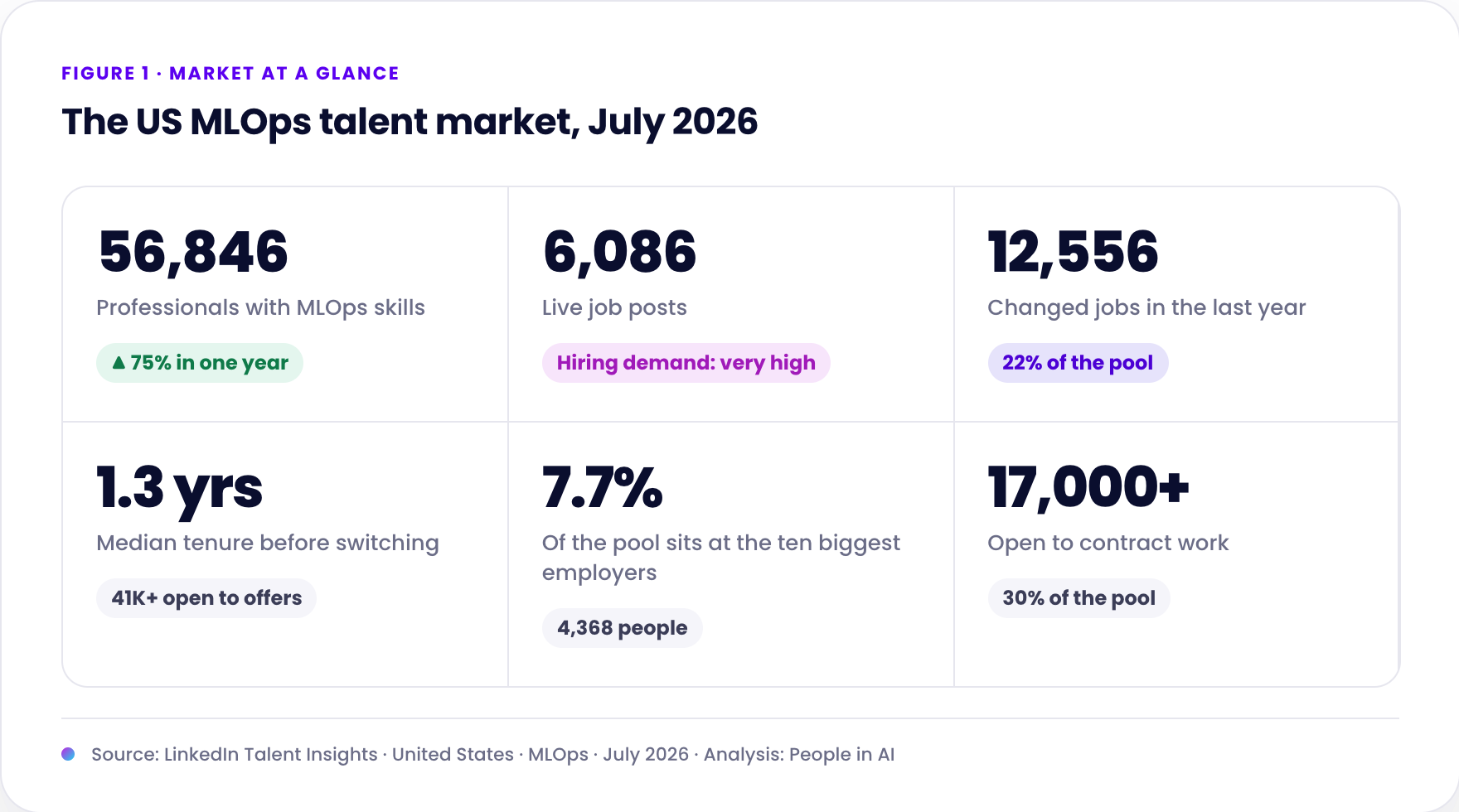
In February 2025 I published The Job Market for MLOps Engineers in 2025. It was a straightforward read of LinkedIn Talent Insights data, and it ended up quoted, linked and lifted more than anything else on our site. Enough people have asked for an update that I've run the identical query — United States, MLOps skill — and put the two side by side.
Same lens, twelve months apart. What follows is the whole report: how big the pool is now, what these people are actually called, which skills are exploding, where the work moved, who's hiring, who quietly stopped, and what all of it means whether you're looking for a job or trying to fill one.
The one-line version
MLOps stopped being a job title and became a job requirement — and the growth, the geography and the hiring have all moved with it.
Ten things that changed in twelve months
- The US MLOps talent pool grew 75%, from roughly 32,500 to 56,846 professionals — about 470 new people a week.
- Supply nearly doubled and hiring demand is still rated very high. 6,086 live posts; 12,556 people changed jobs.
- "MLOps Engineer" is not a top-ten title among people with MLOps skills. Not top ten. Not close.
- Generative AI Engineer is the fastest-growing title at +263%. Artificial Intelligence Engineer is now the second most common title in the pool and grew 140%.
- Retrieval-Augmented Generation is the fastest-growing skill at +298%, now on 16,708 profiles. It didn't feature in last year's report at all.
- Amazon and AWS both shrank their MLOps headcount (−9% and −8%) while the national pool grew 75%.
- Dallas–Fort Worth doubled (+100%) and is now the third-largest MLOps market in the country, ahead of Washington DC and Seattle.
- Banking grew 154%, Capital Markets 120%, Hospitals & Health Care 110% — all far ahead of Software Development at 58%.
- Washington DC is now the tightest market in America — nearly twice as many job posts per professional as anywhere else.
- Median tenure before switching is 1.3 years, and Amazon's MLOps attrition is running at 27%.
A talent pool that nearly doubled
Last year I wrote that there were "tens of thousands" of MLOps professionals in the United States. I was being deliberately vague. This year I don't have to be: LinkedIn counts 56,846, with 75% one-year growth. Work backwards and the pool was around 32,500 a year ago. Roughly 24,000 people joined it in twelve months — about 470 a week.
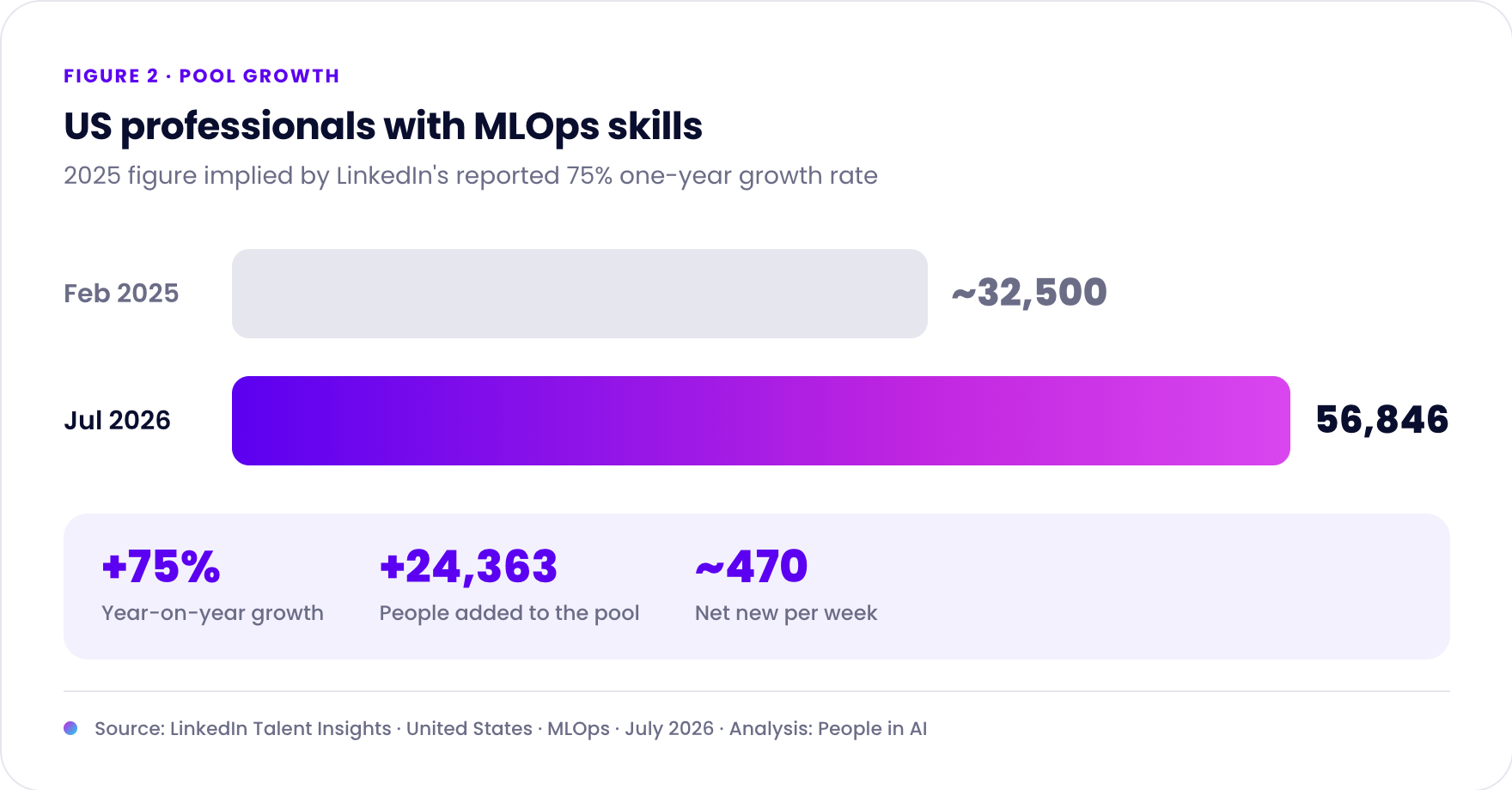
Nobody trains 24,000 MLOps engineers in a year. Growth at that speed is mostly relabelling: platform engineers, data engineers, DevOps engineers and backend people adding MLOps to their profile because it now describes a real part of their week. That is exactly what you'd expect from a discipline moving out of specialist territory and into the default toolkit.
It's worth saying plainly: LinkedIn measures what people say about themselves. Some of that 75% is language catching up with practice rather than net new capability entering the market. That doesn't make it less useful — knowing what a market calls itself is half the job of finding it.
Here's the number that matters most, though. Supply grew 75% and LinkedIn still rates hiring demand as very high — "this talent is very hard to hire." A market that absorbs 24,000 extra people and stays tight isn't a bubble. It's a structural shortage.
MLOps is a skill now, not a job title
This is the finding that surprised me most, and the one I'd ask every hiring manager reading this to sit with for a second. Take the 56,846 people who list MLOps, ask what their job titles actually are, and "MLOps Engineer" doesn't make the top ten.
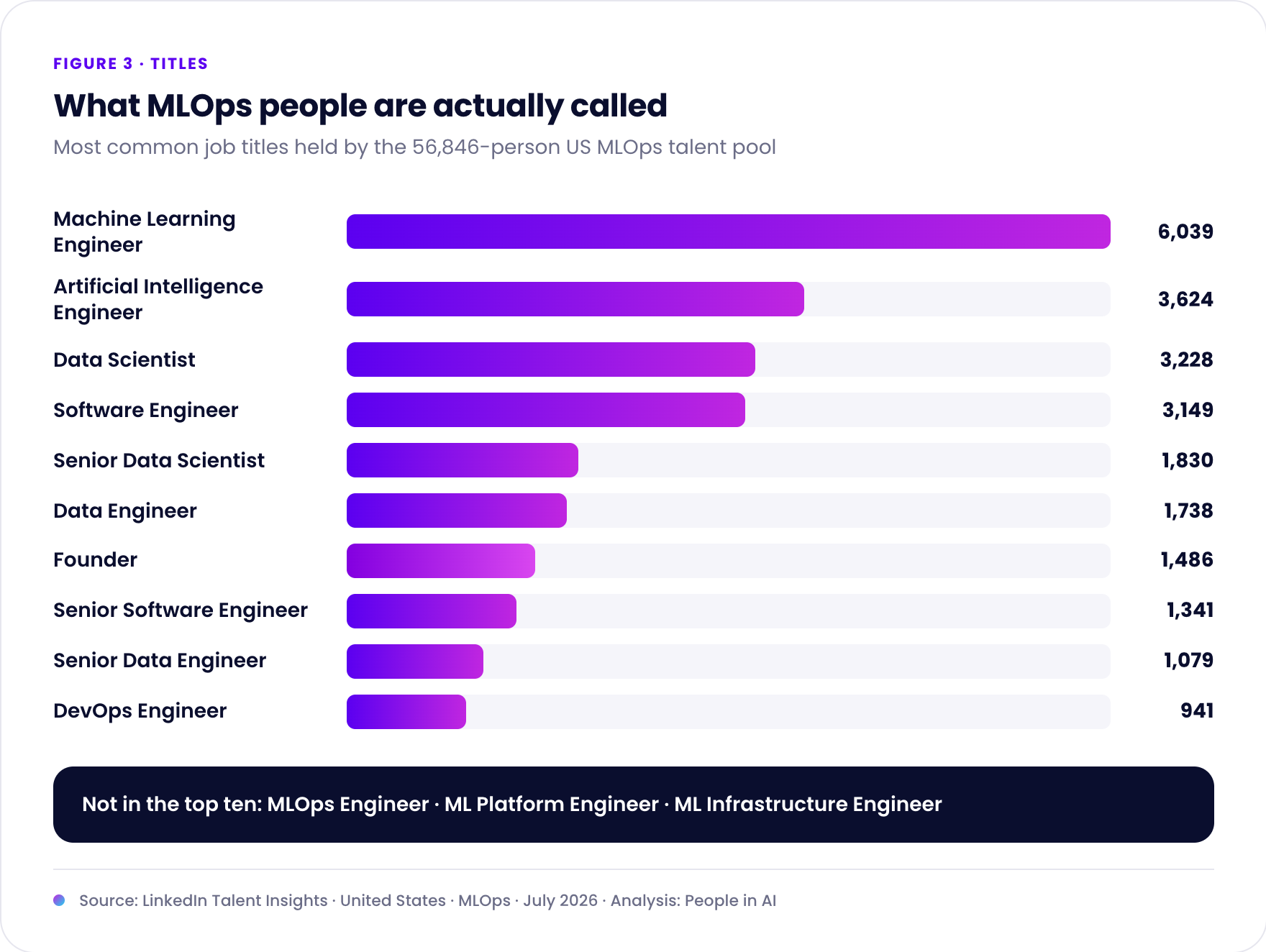
Machine Learning Engineer leads on 6,039 people (11% of the pool), followed by Artificial Intelligence Engineer, Data Scientist and plain Software Engineer. There are 1,486 Founders in this pool — 3% of everyone with MLOps on their profile has gone off to start something. That's a quietly significant leak in the supply.
The growth rates tell you where the labels are heading next.
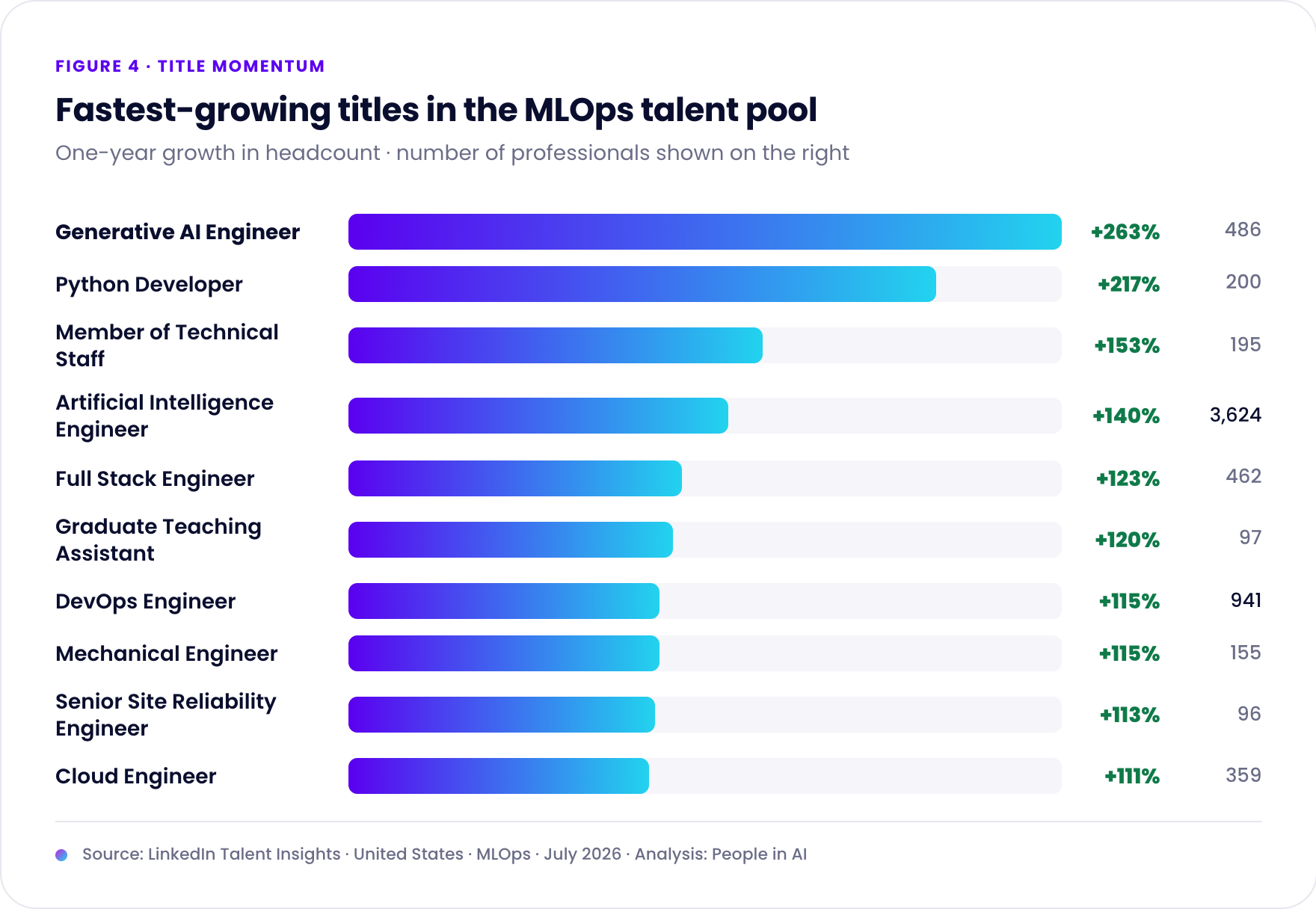
Three signals in that chart. First, the AI-native titles are eating the ML-native ones: Generative AI Engineer at +263%, and AI Engineer at +140% off a base of 3,624, is a title genuinely displacing others. Second, Member of Technical Staff grew 153%, and its top employers are Anthropic, OpenAI and Microsoft AI — the frontier labs' title convention is leaking into the wider market. Third, DevOps Engineer grew 115% and Cloud Engineer 111%: traffic into MLOps is arriving from the infrastructure side just as fast as from the modelling side.
What I'd do with this
If your job ad is headed "MLOps Engineer," you are advertising into a title almost nobody in this pool claims. Search and advertise on skills and stack, not titles — and be ready for your best candidate's profile to say "Senior Software Engineer." On the candidate side: what's written under your name matters less than the stack beneath it, but if you're optimising for recruiter search traffic, "AI Engineer" and "ML Platform Engineer" are where the volume is going.
The skills that define the role in 2026
Last year's skills list read: cloud platforms, Docker and Kubernetes, TensorFlow and PyTorch, Kubeflow and MLflow, Python, ETL basics, Jenkins and Terraform. Solid, and mostly still true. But the base of the pyramid isn't where the action is. Here's what everyone already has:
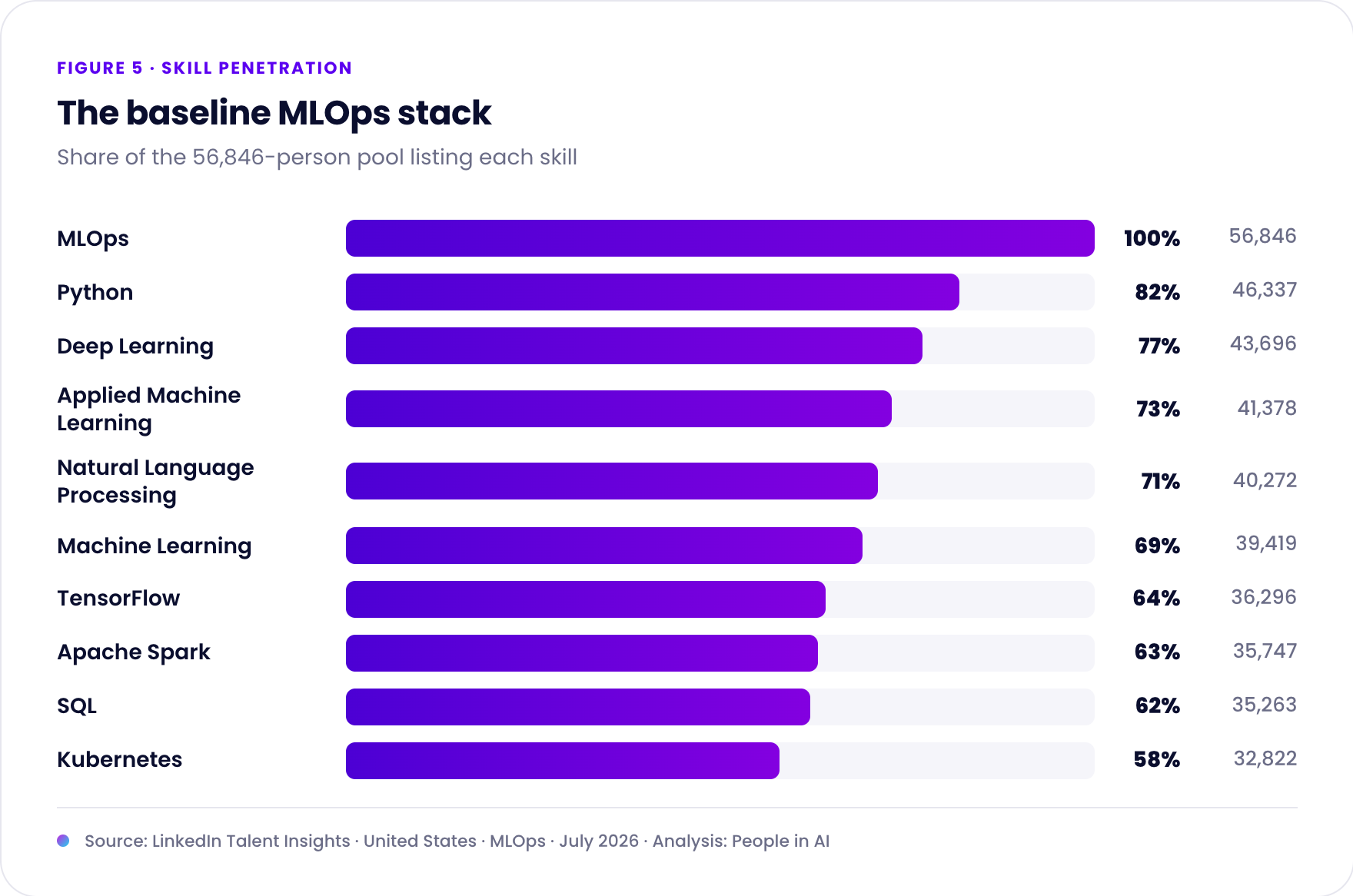
That's the price of entry, and it hasn't changed much. Now look at what's actually moving — and note these aren't fringe niches. RAG alone is on 16,708 profiles.
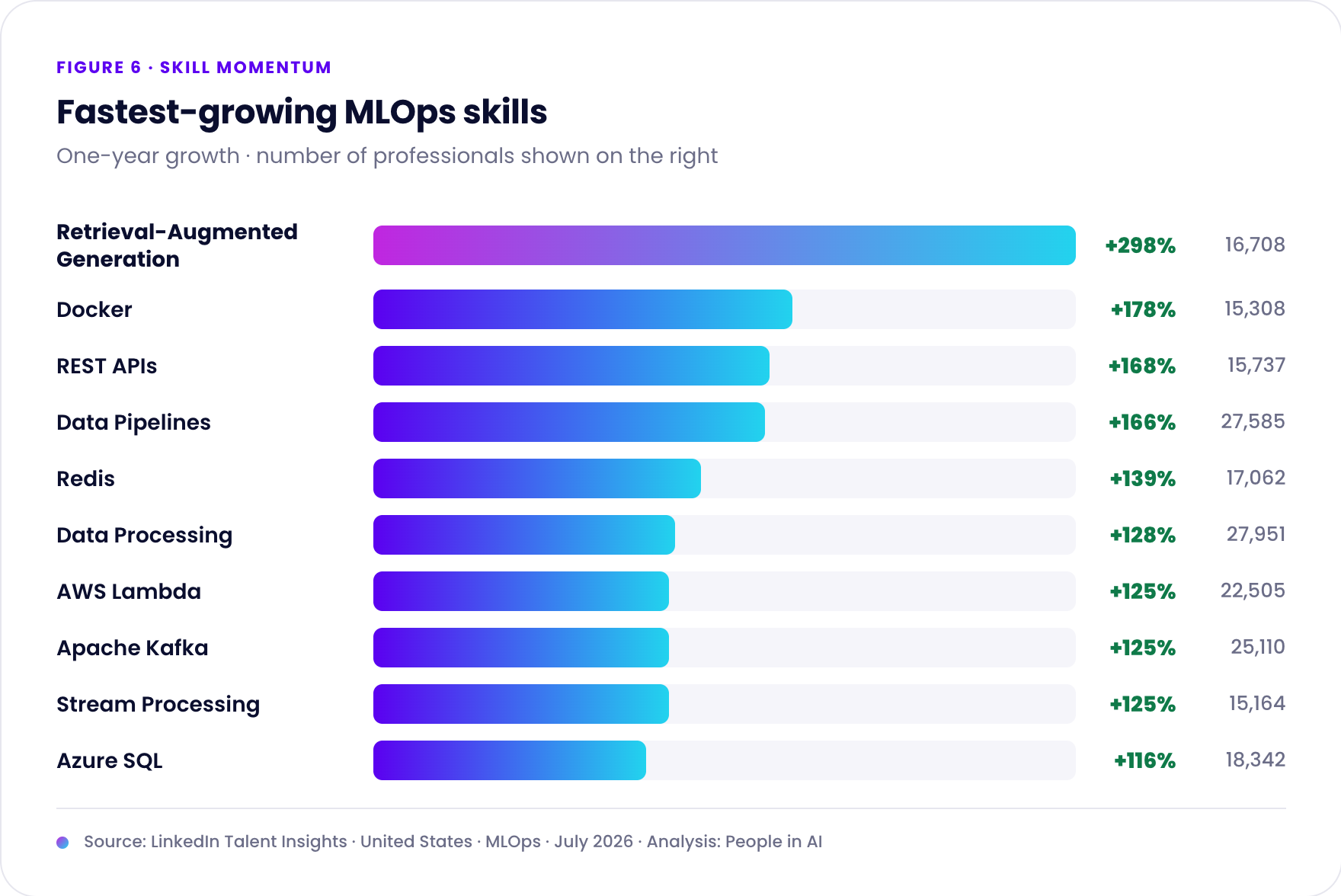
There are three stories buried in that list, and they're the most important part of this whole report.
1. The generative AI stack has become MLOps' problem
RAG at +298% is not a fringe skill — 16,708 people, nearly a third of the pool, now list it. The supporting cast says the same thing: Redis growing 139% in this population isn't about page caching, it's vector search and feature serving. When somebody hires an "MLOps engineer" in 2026, a large share of the actual work is retrieval pipelines, embedding stores, context plumbing and evaluation harnesses for non-deterministic systems.
2. The centre of gravity moved from training to serving
REST APIs +168%, Docker +178%, AWS Lambda +125%, Kafka +125%, Stream Processing +125%, Data Pipelines +166%. Every one of those is about moving data and answering requests, not about building models. The job has drifted decisively towards inference infrastructure, latency, cost and data movement. If I were writing an MLOps spec today, serving and streaming would sit above training frameworks on the list.
3. The named MLOps platforms have gone quiet
Last year I singled out Kubeflow and MLflow as "new platforms requiring dedicated experts." Neither appears in the top skills or the fastest-growing skills this year. That's not decline so much as commoditisation — knowing MLflow is table stakes now, not a differentiator. Meanwhile TensorFlow still sits on 64% of profiles, which tells you how long a skill lives on a CV after it stops being the thing people reach for. Read penetration as history; read growth as the present.
One skill the data can't see yet, but which comes up in nearly every search we run: evaluation and observability for LLM systems. There's no clean profile keyword for it, and every serious client asks about it. If you're a candidate looking for an edge, that's the gap I'd fill.
Where the work moved
Last year the geography story was simple: Bay Area, New York, Seattle and Boston, with Dallas, Atlanta and DC listed as "emerging." One of those emerged rather faster than the rest.
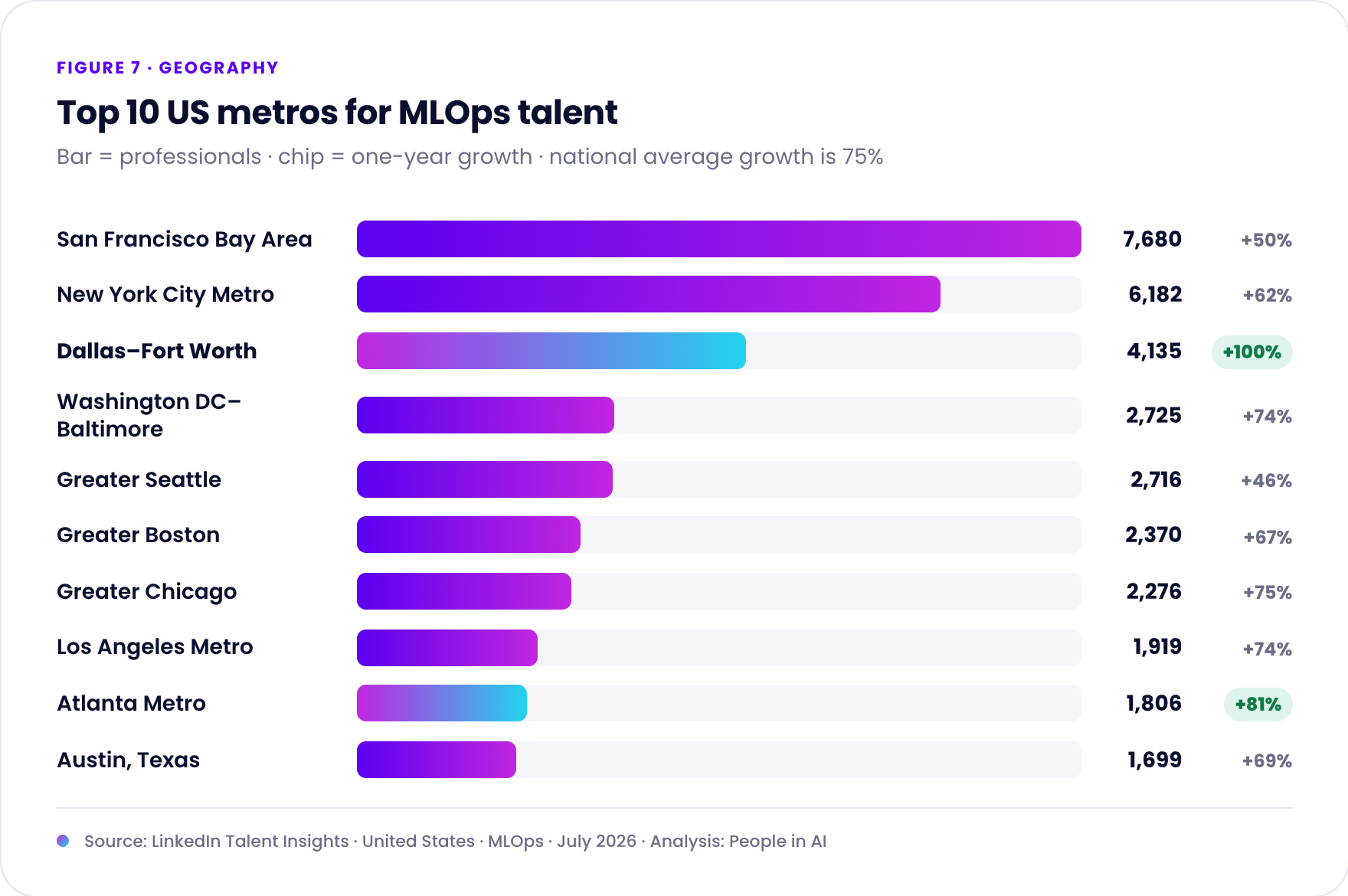
Dallas–Fort Worth doubled. It's now the third-largest MLOps market in the United States, ahead of Washington DC and Seattle, and its top employers there are AT&T, JPMorgan Chase and CVS Health. Not one of them is a technology company. That single data point is the whole 2026 story in miniature.
The Bay Area is still number one by a distance at 7,680 people, but it grew 50% against a national rate of 75% — growing in absolute terms while losing share. New York (+62%) is in the same position. Seattle grew slowest of the top ten at 46%.
And here's a line I did not expect to write: LinkedIn now flags Seattle, Boston and Chicago as "hidden gem" locations — places where the supply of professionals is high relative to hiring demand. Boston's hiring demand is rated merely moderate. Twelve months ago I listed Seattle and Boston as prime markets. Today the data says they're where candidates outnumber the roles.
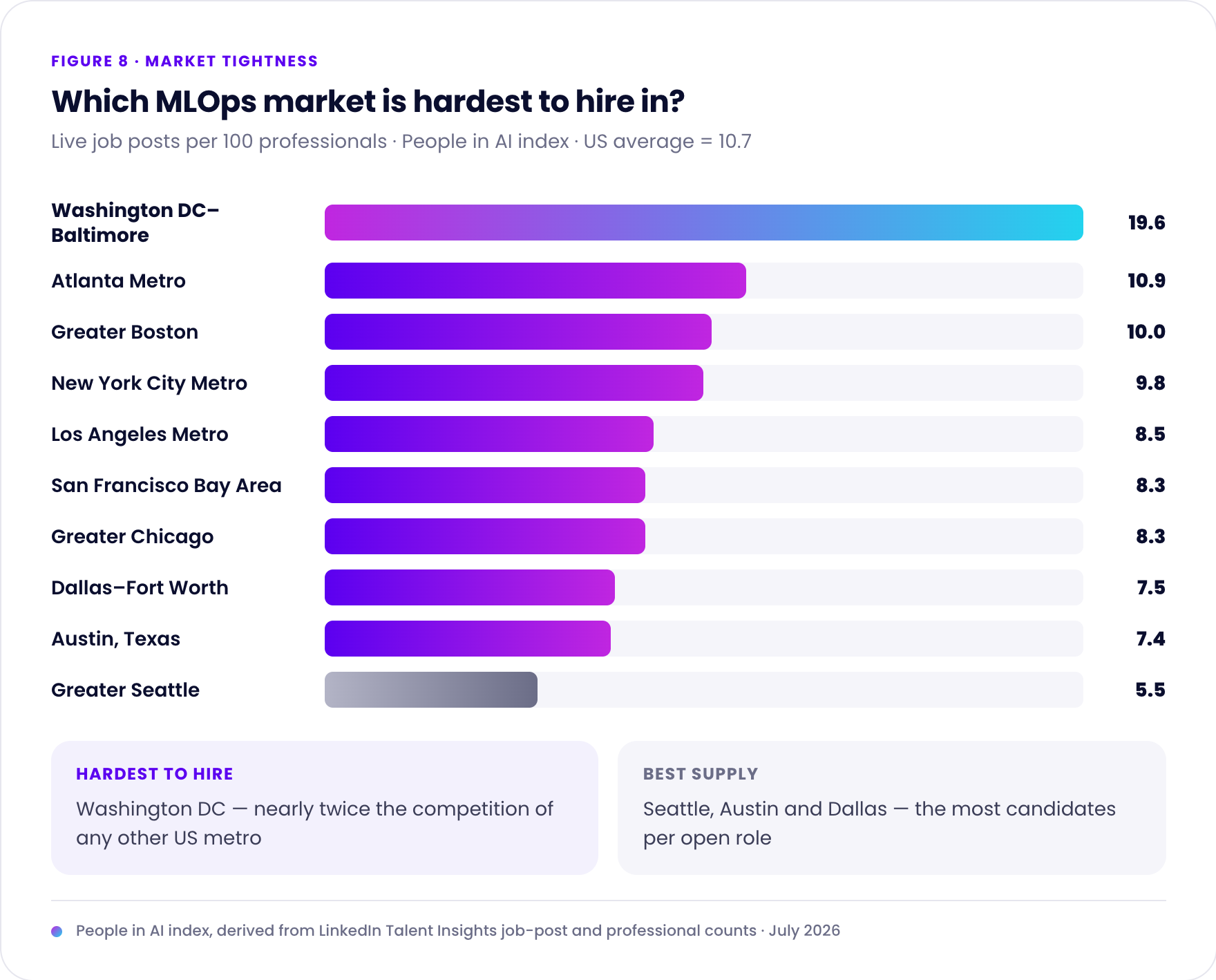
That index is ours, not LinkedIn's — job posts divided by professionals, which is the crudest useful measure of how many recruiters are chasing the same person. Washington DC comes out at 19.6, nearly double the next metro. Its top employers are Capital One, AWS and Booz Allen Hamilton: regulated, cleared, government-adjacent AI work, where the candidate pool is narrowed further by citizenship and clearance requirements. If you're hiring MLOps in DC, you are in the hardest market in the country and should plan your process accordingly.
Note too that the national ratio is 10.7 and seven of the ten biggest metros sit below it. Postings are increasingly landing outside the classic hubs — or carrying no location at all.
Who's hiring — and who quietly stopped
This is where the report stopped being predictable. The two largest employers of MLOps talent in America both got smaller.
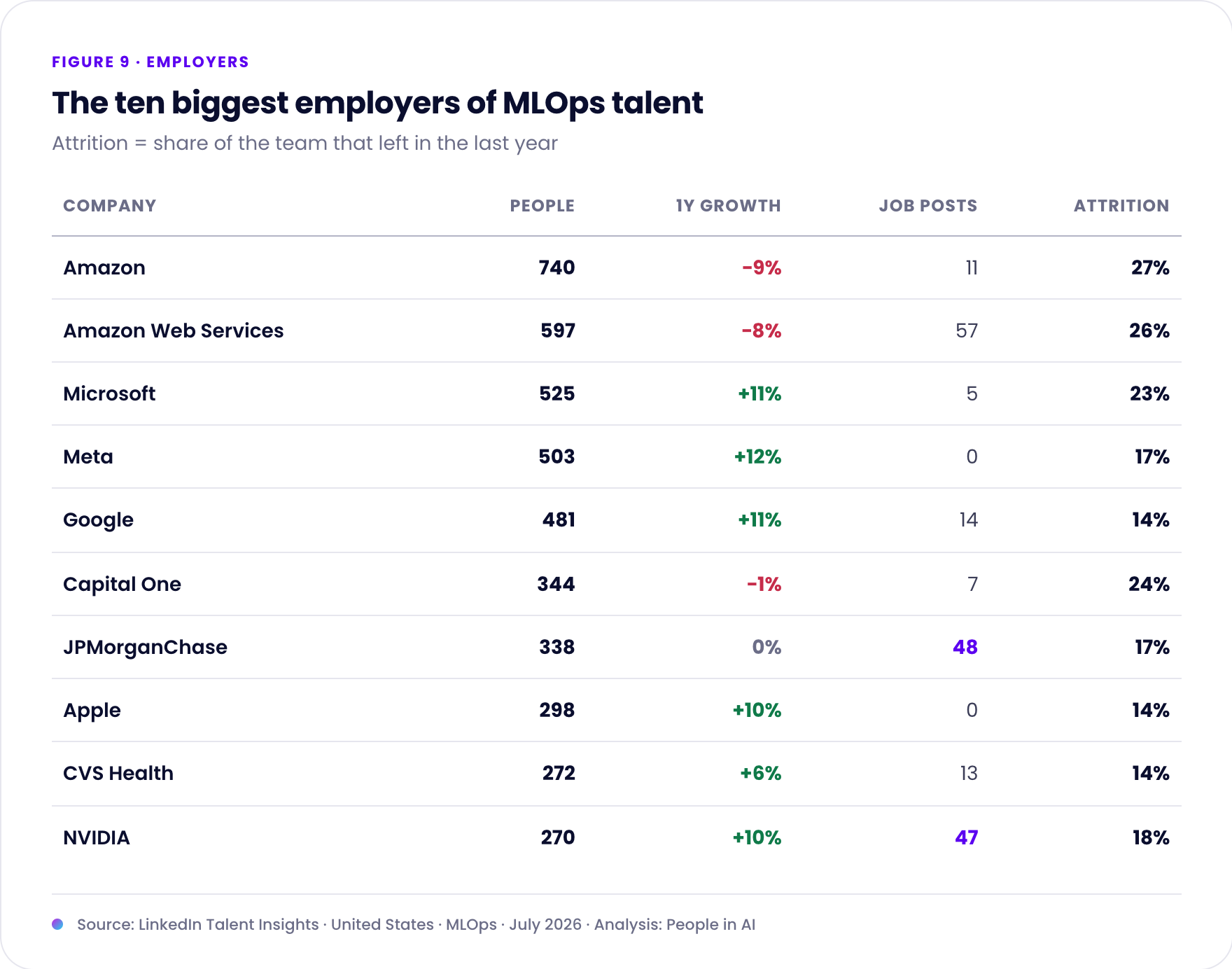
Amazon is down 9% and AWS down 8% — together roughly 125 fewer MLOps people than a year ago, in a market that added 24,000. Microsoft, Meta, Google, Apple and NVIDIA all grew, but at 10–12% against a market growing at 75%. Big tech didn't stop hiring. It simply stopped being where the growth is.
Job posts show intent better than headcount does. AWS has 57 live roles, JPMorganChase 48 on a base of 338, NVIDIA 47 on a base of 270. A bank and a chip company are hiring at the highest intensity relative to the teams they already have. Meta and Apple: zero posted roles.
The concentration number is the one I'd underline. The ten biggest employers hold 4,368 people — 7.7% of the pool. This market has no gravitational centre. Last year I wrote that competition isn't limited to other tech companies; this year the data says the tech companies aren't even the growth story.
And look at the attrition column if you're sourcing. Amazon 27%, AWS 26%, Capital One 24%, Microsoft 23% — roughly a quarter of those teams turned over in a year. Google, Apple and CVS Health sit at 14%. That gap tells you where the movers are.
A note on salary
I've deliberately left compensation figures out of this year's analysis. LinkedIn's reported averages don't match what we see agreed at offer stage — real total compensation at the senior end of this market is materially higher than the platform suggests, particularly once equity is counted. Rather than publish a number I don't believe, I'd rather say: if you want a grounded read on what a specific MLOps or ML platform role pays in your market, talk to us and we'll tell you what's actually being signed.
Banks and hospitals are the growth story
If big tech isn't driving the growth, who is? The industry view answers it clearly.
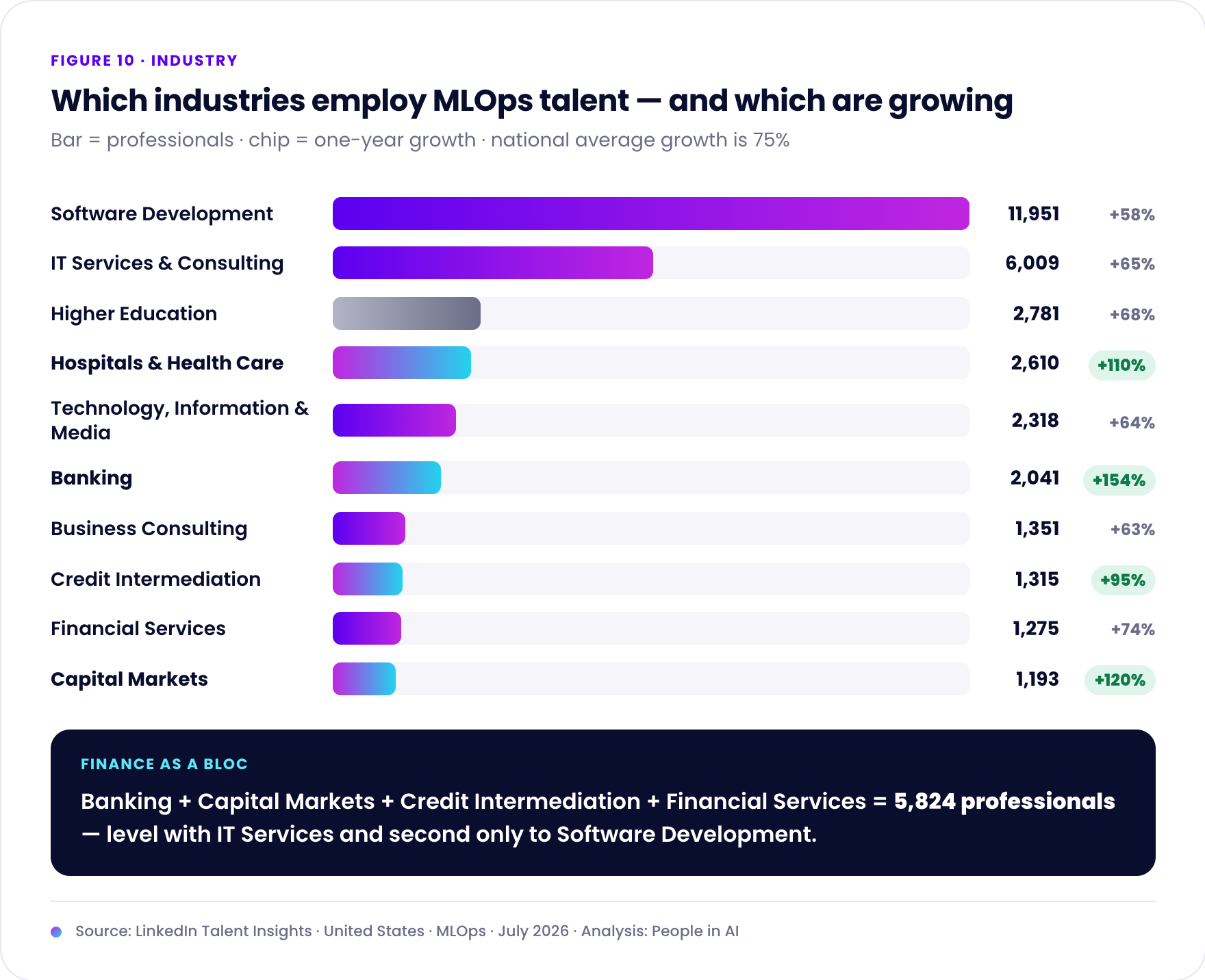
Software Development is still the largest single industry at 11,951 people, but it grew 58% — below the national rate. Banking grew 154%. Capital Markets 120%. Credit Intermediation 95%. Hospitals & Health Care 110%. Group the finance categories together and you get 5,824 professionals, which as a bloc is essentially level with IT Services and second only to Software Development.
One more line in that table deserves attention: Higher Education has 2,781 MLOps professionals, grew 68%, and posted 24 jobs. Hiring demand: low. Universities are producing this talent in volume and have almost no capacity to keep it. If you're building a pipeline programme, that's your source.
For non-tech employers the implication has flipped. A year ago I was telling banks and hospitals they'd have to pitch hard against Google. Today they're the growth engine of this market — and their real competition is each other.
This is an extremely liquid market
12,556 of these 56,846 people changed jobs in the last twelve months. That's 22% of the entire pool. Median tenure before switching is 1.3 years. And 41,000+ — roughly 72% of everyone in the pool — are flagged as open to new opportunities.
Two things follow. If you're hiring, your offer is competing against a candidate's assumption that another one arrives next quarter, so speed and clarity of mission beat a drawn-out five-stage process every time. If you're retaining, 1.3 years is the window in which you either give someone a bigger problem or lose them.
The most under-used number in the whole report: 17,000+ of this pool are open to contract work — about 30%. In a market this tight, fractional and contract MLOps is a route most hiring managers haven't seriously priced. It's often how we get a platform stood up while a permanent search runs.
Where this talent comes from
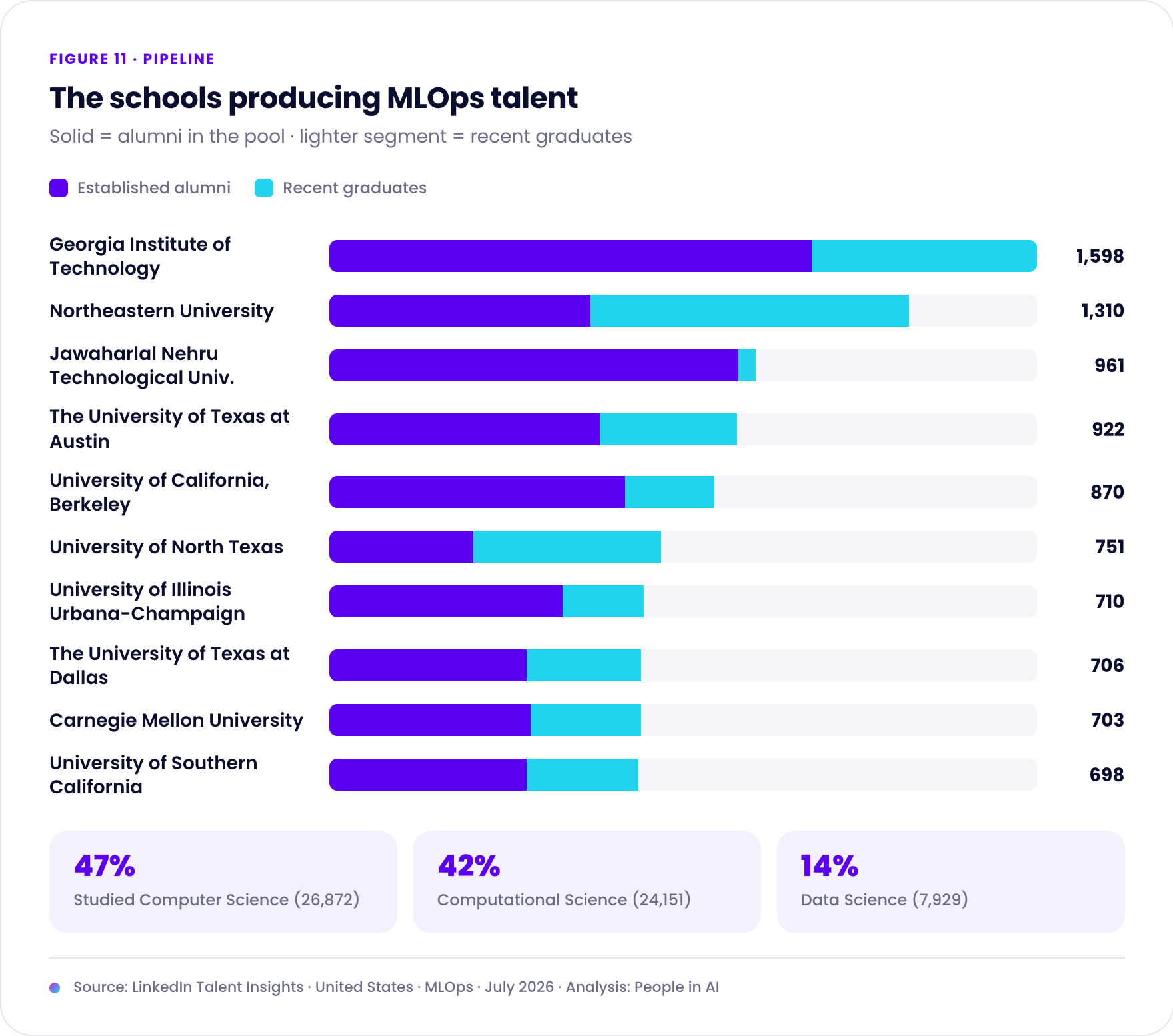
Georgia Tech leads with 1,598 alumni in the pool, 508 of them recent graduates — that's the online master's programme operating at industrial scale. But look at the mix rather than the totals. At Northeastern, 721 of 1,310 alumni are recent grads (55%). At the University of North Texas it's 425 of 751 (57%). Compare that with Berkeley, where recent grads are 23% of its alumni in the pool.
In other words: the pipeline into MLOps is shaped by large master's programmes, not elite undergraduate computer science — and it's disproportionately Texan and Southeastern. Which is precisely the same map as the Dallas and Atlanta growth story above. Talent is being produced where it's now being hired.
One number that hasn't moved and should: the pool is 76% male and 24% female. A discipline growing 75% a year has more freedom than most to change its shape, and it isn't using it.
What to do about it
If you're a candidate
- ›Get retrieval, serving and evaluation on your CV. RAG, streaming and inference infrastructure are where the growth is.
- ›Don't over-index on platform tools. MLflow and Kubeflow are assumed now, not differentiating.
- ›Look outside tech. Banks, capital markets firms and health systems are growing this function two to three times faster.
- ›Consider DC, Atlanta and Boston. The competition per candidate is highest where the roles outnumber the people.
- ›Make your profile findable on skills, not just your title — that's how you'll be searched for.
If you're hiring
- ›Search on skills, not the title "MLOps Engineer" — you'll miss most of the market otherwise.
- ›Source from Seattle, Boston and Chicago, where supply outruns local demand.
- ›Target teams with 23–27% attrition. Movement is where the movers are.
- ›Move fast. Median tenure is 1.3 years and 72% of the pool is open to offers — so is your candidate.
- ›Price contract properly. 30% of this pool will consider it, and it de-risks a long permanent search.
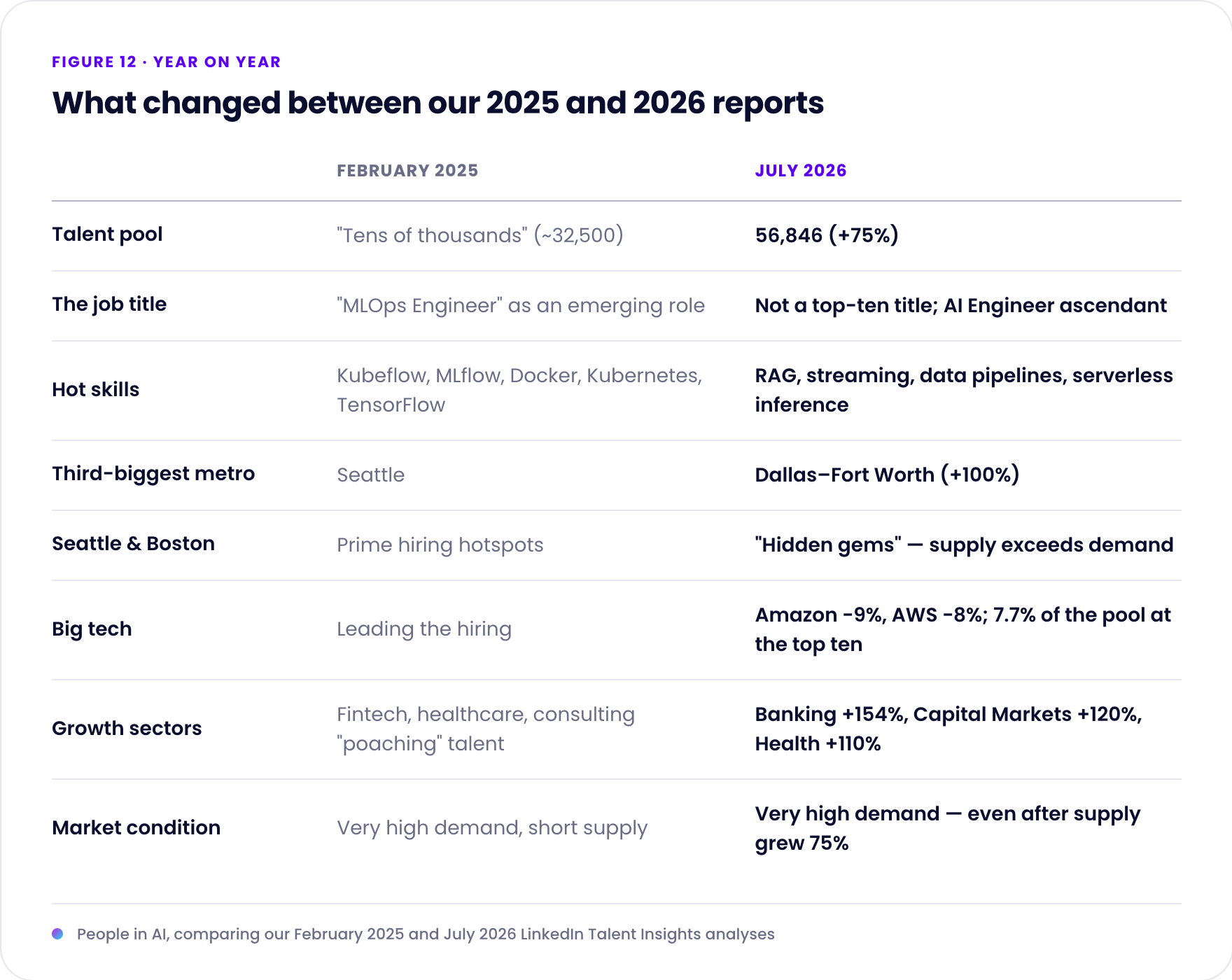
2025 vs 2026, side by side
Final thoughts
Last year I summed the market up in one word: thriving. It still is — but it has changed character. In 2025 MLOps was a scarce specialism concentrated in technology companies on two coasts. In 2026 it's a widely-held capability, growing fastest inside banks, hospitals and consultancies, spreading into Texas and the Southeast, and increasingly defined by generative AI infrastructure rather than classical model deployment.
The paradox worth holding onto is that supply grew 75% and hiring is still rated very hard. That happens when the definition of the job moves faster than people can retrain into it. The 56,846 number is real, but the subset who have genuinely run generative AI systems in production, at scale, under cost and latency pressure, is a fraction of it. That's the group everyone is actually competing for.
My advice hasn't fundamentally changed, only sharpened. Candidates: go where the plumbing is hardest, and learn to prove your systems work rather than just that they run. Hiring managers: stop recruiting for a title and start recruiting for a stack, look outside the two coasts, and move quickly when you find someone good — because in a market with 1.3-year median tenure, so is everyone else.
Hiring MLOps talent, or thinking about your next move?
We place MLOps, ML platform and AI infrastructure engineers across the US and Europe — and we'll tell you honestly what a role should pay and how long it will take to fill. Have a look at our areas of expertise or get in touch.
Frequently asked questions
Is MLOps still a good career in 2026?
Yes. The US talent pool grew 75% in a year to 56,846 people and LinkedIn still rates hiring demand as very high, meaning employers are finding this talent very hard to hire even after supply nearly doubled. There were 6,086 live US job posts requiring MLOps skills at the time of writing.
Is MLOps being replaced by AI engineering?
It's being absorbed rather than replaced. "MLOps Engineer" is no longer a top-ten job title among people with MLOps skills; the most common titles are Machine Learning Engineer (6,039) and Artificial Intelligence Engineer (3,624, up 140%), while Generative AI Engineer grew 263%. The work hasn't gone away — the label on it has changed.
What skills should an MLOps engineer learn in 2026?
The fastest-growing skills in this talent pool are Retrieval-Augmented Generation (+298%), Docker (+178%), REST APIs (+168%), data pipelines (+166%), Redis (+139%), and a cluster of streaming and serverless technologies including Kafka, stream processing and AWS Lambda (all around +125%). Python, Kubernetes and SQL remain baseline expectations rather than differentiators.
Where are the most MLOps jobs in the United States?
By talent concentration: the San Francisco Bay Area (7,680), New York City (6,182) and Dallas–Fort Worth (4,135). By competition for candidates, Washington DC–Baltimore is the tightest market in the country, with roughly 19.6 job posts per 100 professionals — nearly double any other metro. Seattle, Boston and Chicago currently have the most available supply relative to demand.
Which industries hire the most MLOps engineers?
Software Development is still the largest employer (11,951 professionals), followed by IT Services and Consulting (6,009). But the growth is elsewhere: Banking grew 154%, Capital Markets 120%, Hospitals and Health Care 110%, and Credit Intermediation 95% — all well ahead of Software Development's 58%. Taken together, financial-services categories now account for 5,824 professionals.
How hard is it to hire an MLOps engineer right now?
Hard, but the market is unusually liquid, which works in a hiring manager's favour if the process is quick. 12,556 people — 22% of the pool — changed jobs in the last year, median tenure before switching is 1.3 years, more than 41,000 are flagged as open to new opportunities and over 17,000 will consider contract work.
Methodology
All headline figures come from a LinkedIn Talent Insights Talent Pool Report for the United States, filtered on the MLOps skill and pulled in July 2026. Growth figures are LinkedIn's one-year measures. Comparisons are against our own February 2025 analysis, which used the same query.
Three metrics in this article are derived by People in AI rather than reported by LinkedIn: the implied 2025 pool size (back-calculated from the reported 75% growth rate), the market tightness index (live job posts per 100 professionals), and the finance bloc total (Banking + Capital Markets + Credit Intermediation + Financial Services). Compensation data has been deliberately excluded — see the note above.
One caveat applies throughout: LinkedIn Talent Insights reflects self-reported profile data, so it measures how professionals describe themselves rather than an audited census of capability.
References & further reading
- LinkedIn Talent Insights — Talent Pool Report, United States, MLOps (July 2026).
- People in AI — The Job Market for MLOps Engineers in 2025 (February 2025).
- People in AI — How to Hire MLOps Engineers: A Complete Guide (June 2026).
- People in AI — The Ultimate Guide to ML Platform Engineer Recruitment (June 2026).
- People in AI — Areas of expertise.
About the author
Sam Jones is the founder of People in AI, a specialist AI recruitment firm connecting careers in AI across the US and Europe.