



In a standard tech team, the goal is to ship stable code. In an AI team, there is a constant push between model power and live output. Research needs fast tests and many trials. It is a world of trial and error where failure is part of the path. But a live product needs low lag and steady results.
Many first-time AI founders miss this tension when they hire. They may hire a great researcher who cannot build a solid tool. Or they may hire a coder who does not know how to fix a model that drifts. You need people who can bridge the gap between a lab and a real app. This often means finding engineers who can write code but also grasp the math. They must know how to take a model from a notebook and put it into the cloud.
How role gaps cause hiring mistakes
AI roles are notoriously hard to define. A data scientist at one firm might do the work of an ML engineer at another. This lack of clear role boundaries leads to poor hires when founders guess at what they need. Math-based tests often fail to find the right talent for these roles. Research from the NIH shows that hiring tools often miss skills that depend on context and shared meaning. Instead of just looking at past job titles, you should hire for how well a person can learn. Look for skills in data logic and tool use. An engineer who can adapt to new models is worth more than one who only knows one legacy system. Our guide to technical recruitment for AI roles can help you set a higher bar.
A fast-growing talent market
The market for AI talent is moving at a high speed. More than 60% of enterprise developers now use AI-assisted coding tools according to GitHub's 2024 Octoverse report. This shift means you need people who can use these tools to work faster and better. The global AI market surpassed $200 billion in 2024 per IDC estimates, with ML engineer salaries rising 22% year over year. Founders must act fast and with a clear plan to win the best minds. You cannot wait for weeks to make an offer.
If you find it tough to source great people, look into solutions for AI talent shortages to keep your work on track. Partnering with experts who know the AI field can give you the edge you need to scale.
How to Determine Your First AI Hire Based on Product Architecture
The decision tree for your first AI hire depends on product architecture, not company size. Startups building LLM-powered products need a different first engineer than those training custom vision models. Here is how to match the hire to the stack.
Choosing Between LLM Apps and Custom Models
If you build an app on top of models like GPT-4 or Claude, your needs are clear. You need full-stack engineers who know how to use prompt chains and RAG pipelines. One ML expert can help them evaluate frameworks to keep the quality high. Startups building custom models for tasks like computer vision or reinforcement learning face a harder path. These teams must hire a Machine Learning engineer as their first pick. This person must write training loops in PyTorch daily and run experiments from scratch. Success depends on the deep skills that technical recruitment for AI roles helps you find.
The Founding Engineer vs. The Scale Leader
A big error at the seed stage is hiring for scale too soon. Many founders look for a VP of Engineering with experience from large firms. They might pick someone who led fifty people at a major tech company. But a startup at the start needs a builder, not a manager. You need a founding engineer who can do the work themselves. They must make build-vs-buy choices on databases and set up experiment tracking. Finding this balance is hard for first-time founders. Picking the right person early sets the tone for your whole team's future.
- Audit your tech stack. Decide if you are building a wrapper or a new model.
- Look for builders. Find engineers who can write training loops and set up data pipelines.
- Prioritize daily tasks. Your first hire should spend their time writing code and running tests.
- Check for system skills. Ensure your first pick can choose the right database.
- Balance goals. Hire someone who understands both model performance and product stability.
The First Four Hires: An Ensemble System for AI Teams
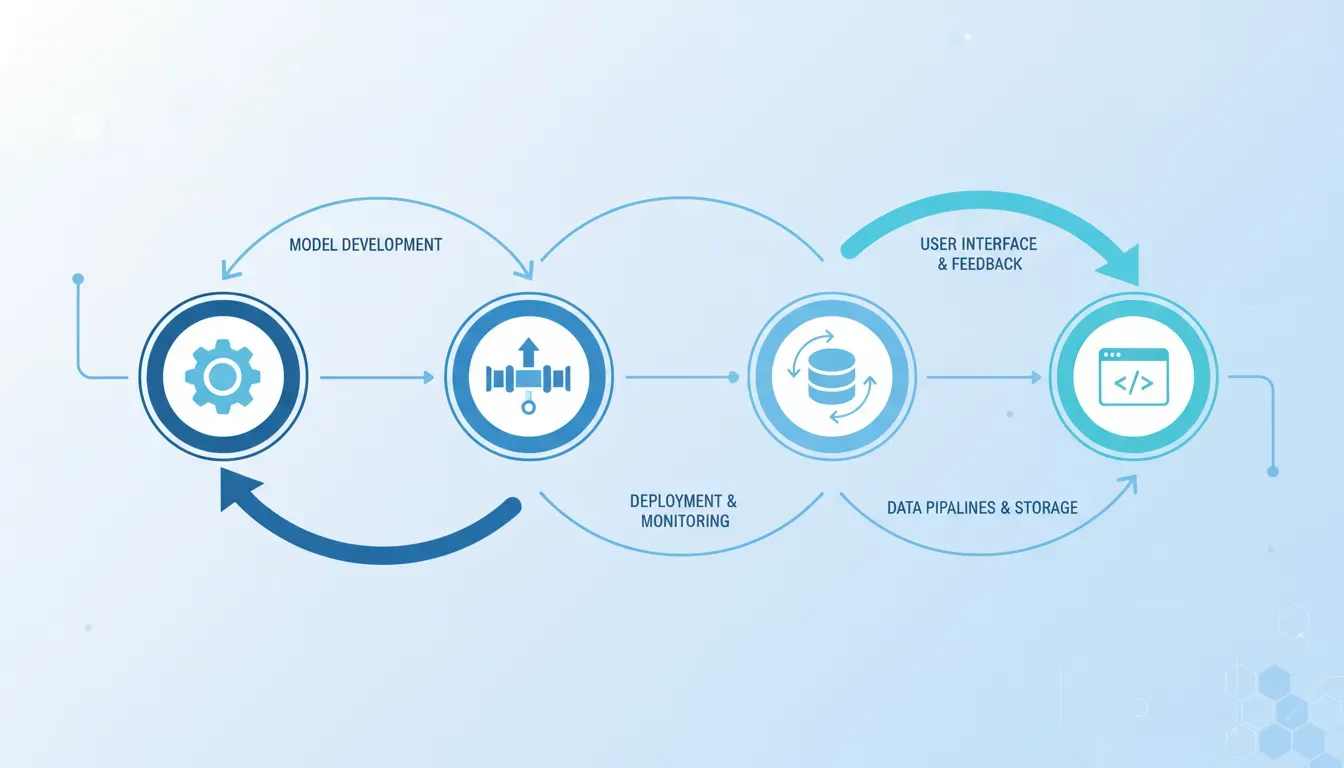
The most resilient AI teams treat their first four hires as a tightly integrated system where each role amplifies the others. This ensemble covers modeling, serving, data infrastructure, and the user-facing product layer. When building an AI team hiring plan, you need all four to close the feedback loop between model outputs and real user experience.
Key roles in the group
The first hire is often a Machine Learning Engineer. This person owns the model logic. They run experiments and use tools like PyTorch, TensorFlow, or JAX. Their goal is to find the best mathematical approach for your task. But a model by itself is not a product. You need a way to deliver that model to users at scale.
The MLOps Engineer owns the serving layer. They build the infrastructure to ship models and monitor them for drift and latency degradation. This role is vital because context-dependent skills in AI can fail when models encounter distribution shift in the wild. They make sure your AI stays reliable after it goes live. A Data Engineer owns the data pipelines. They manage how data flows into your system, including labeling workflows and feature stores. Clean data is the fuel for your AI. Without it, even the best model architectures produce garbage outputs.
The last piece is the Full-Stack Engineer. They own the product surface where users interact with the AI. This role is key to closing the loop. They build the tools to capture user feedback and behavior data. That signal flows back to the data and ML teams to inform the next model iteration.
When to Add an MLOps Engineer Versus a Data Engineer
One of the most common scaling questions founders face is which specialist to hire first. The answer depends on where your team's bottleneck is. A simple framework: hire MLOps when infrastructure consumes your team, hire Data Engineering when data complexity overwhelms your pipeline.
The MLOps Engineer Trigger
You should hire an MLOps engineer when your team spends too much time on infrastructure. A good heuristic is the 30 percent threshold. If your team spends over 30 percent of their day on deployment and monitoring instead of model development, you need an MLOps expert. This shift often happens when you must retrain models more than once per week. At first, basic tools like SageMaker or Vertex AI are usually enough. As you scale, model governance becomes a priority, especially if your models process human behavioral data where fairness and bias monitoring matter.
The Case for a Data Engineer
A data engineer is the right hire when your data complexity outgrows what your ML engineer can handle alone. You need this role if you deal with data versioning, complex pipeline orchestration, or multi-source feature engineering. They handle quality checks and data label workflows. This role is critical when you have large data sets that change fast. You can delay this hire if your data stays small or static.
| Role | Main Trigger | Key Responsibility | Common Tools |
|---|---|---|---|
| MLOps Engineer | Infrastructure tasks take more than 30 percent of engineering time | Model deployment and monitoring | Kubeflow, MLflow, BentoML |
| Data Engineer | Complex feature pipelines outgrow manual handling | Data quality and versioning | dbt, Airflow, Spark |
Common AI Team Hiring Mistakes and How to Avoid Them
Building an AI team is a high-stakes task with recurring failure patterns. Many leaders make the same errors when they start technical recruitment for AI roles. Recognizing these patterns early can save months of churn and misdirected budget.
Why big company leaders fail at the seed stage
Early founders often hire a VP of Engineering from a huge tech firm. These leaders know how to manage many people. But a seed-stage company needs a hands-on builder. You need someone who can write training loops and track each experiment. At the start, your leader must be able to make build-or-buy choices for your data tooling. Hiring for scale too soon can leave you with a leader who does not code. This choice can stall your first product launch.
The risk of notebook-only engineering
Many ML candidates come from research labs. They build great models in Jupyter notebooks. But shipping code to real users at scale is a different skill. A team that only produces notebooks cannot build a live application. You must find engineers who know how to deploy code to production. Without this, your projects will stay as experiments. You should look for solutions for AI talent shortages that focus on engineers who ship production code.
When infrastructure stops model progress
Founders often skip the MLOps hire at first. They think their ML engineer can handle the servers and data pipelines alongside model work. Soon, that engineer spends most of their day on DevOps. They stop training models and start fixing broken deployment pipelines. This creates a major bottleneck for your team. You should hire an MLOps expert as soon as your infrastructure becomes a burden.
Structuring Your AI Team for Growth and Adaptability
As startups reach the growth stage of 50 to 500 people, the need for structured hiring processes grows. Early teams often thrive on a few generalists. But a scaling organization needs more depth. You must shift from a small group to a full AI unit with clear feedback loops and high evaluation standards.
Hire for cognitive adaptability
The best AI hires show high cognitive adaptability and tool fluency. In a fast-moving field, fixed roles can become obsolete quickly. You should look for professionals who can reason through data and adopt new model architectures. This focus on skills over titles is key for teams that want to stay agile. As the pace of framework releases accelerates, the ability to learn a new tool in a week matters more than five years of experience with an older framework.
Founders often find it hard to scale their technical bar and culture simultaneously. You need a process that evaluates for both. Hiring for tool fluency helps your team adopt new coding assistants and ML frameworks as the ecosystem evolves.
Build an evaluation culture
Scaling a team means you cannot be in every interview. You must establish a culture of strong evaluation. Use clear frameworks to assess how a candidate balances model performance versus reliability. This helps you move from generalists to specialists in a smart way. You can add depth in research and infrastructure as your product grows more complex. Our hiring solutions are built for companies in this growth stage.
How to Find and Evaluate Specialized AI Talent
Finding the right AI talent is a major hurdle for new firms. Most teams look in the same spots, but the best experts are often hidden in research communities and open source projects. You need a clear plan to find and evaluate these people fast.
Sourcing technical talent beyond job boards
Standard job sites often fail to surface top AI engineers. Many experts do not browse common job boards. They stay in private research circles or contribute to open source projects. You should look at GitHub for engineers who build new tools and at ArXiv for authors who publish on new model architectures. People In AI delivers top candidates within 3 days of a brief, helping you skip the slow start of most hiring cycles.
Screening for framework skill and production experience
Once you find a candidate, you must evaluate their real skills. Theoretical AI knowledge is not enough. They need to use common frameworks well. Good technical recruitment for AI roles tests for ML framework proficiency. Most top roles require skill in PyTorch, TensorFlow, or JAX. Ask them how they have launched models for users. A candidate who can train a model but not serve it at scale will slow your team down.
- Data drifts and model decay monitoring.
- System latency and inference optimization.
- Scaling models from single-node to distributed serving.
Some firms use automated tools to screen for these skills. But automated hiring assessments can fail to capture context-dependent skills that only emerge in real engineering environments. You still need a human touch in your screening process.
Balancing output speed with quality
When you need AI engineers now, the tension between speed and quality is real. You must build a process that moves fast without lowering your bar. The best approach is to use structured technical interviews that test real production skills, combined with a strong sourcing network. People In AI provides a 3-day delivery model that helps you move from brief to shortlist quickly without sacrificing screening depth. Our hiring solutions are tailored for AI teams at every stage of growth.
Frequently Asked Questions
What is the first hire I should make for my AI startup?
The answer depends on your product architecture. If you are building on top of existing LLMs, your first hire should be a full-stack engineer with experience in prompt engineering and RAG pipelines. If you are training custom models, hire a Machine Learning Engineer who can write training loops in PyTorch and manage experiment tracking.
How many people do I need for an AI team?
Start with two to three people: a Machine Learning Engineer, a data-focused engineer, and a full-stack engineer. As you scale, add an MLOps engineer when infrastructure tasks consume more than 30 percent of your team's time and a dedicated Data Engineer when your data pipeline complexity outgrows what your ML engineer can manage alone.
What is the difference between an MLOps Engineer and a Data Engineer?
An MLOps Engineer focuses on model deployment, monitoring, and infrastructure for serving predictions at scale. A Data Engineer focuses on building and maintaining data pipelines, feature stores, and data quality monitoring. Both are essential but solve different bottlenecks as your team grows.
Should I hire a VP of Engineering first?
Not at the seed stage. Early on, you need a hands-on builder who can write code and set up infrastructure, not a manager. A founding engineer who can do the work themselves is far more valuable than a leader who has only managed large teams at established companies.
Ready to Build Your AI Team?
Building the right AI team is the single highest-leverage decision a founder makes. The difference between a team that ships and one that stalls comes down to hiring the right roles in the right order. At People In AI, we specialize in AI/ML recruitment with a 3-day candidate delivery model and a track record of reducing time-to-hire by 40 percent. Schedule a free hiring consultation to get started.
Most AI startups fail because they underestimate the tension between model performance and production reliability. Over 60% of ML projects stall before reaching production according to a 2024 Gartner survey, and the root cause is almost always a misaligned hiring strategy. Scaling a machine learning team requires a different playbook than traditional software hiring.
Building an AI team hiring requires a strategic roadmap that prioritizes role sequencing over rapid headcount growth. This guide shows how to hire machine learning engineers, data engineers, and MLOps experts to ensure your models work well in production. You will learn how to find your first hire based on your specific product architecture and technical needs. By following this plan, founders can avoid common mistakes like hiring for scale too early or choosing the wrong specialist for their stack. This roadmap provides the steps needed to scale your AI team successfully.
Building AI Team Hiring: Why Building an AI Team Is Different from Traditional Software Hiring
An AI startup at seed stage needs a fundamentally different team composition than a SaaS company at the same stage. Where a SaaS founder needs a full-stack web engineer and a product designer. An AI founder needs someone who can write training loops, manage data pipelines, and serve model inferences at low latency. The core work is not deterministic code that follows a fixed execution path; it is building systems that learn and degrade unpredictably in production.
This shift means conventional hiring playbooks break down. You are not looking for people who can build a CRUD app. You need minds that can handle the math and the data behind it. When you start your search, you must think about the long term. A bad hire in these early days can slow down your work for months.


