


An AI implementation engineer is the specialist who converts trained machine learning models into reliable, scalable production systems that real users interact with every day. Unlike AI research scientists who push the boundaries of model accuracy, implementation engineers own the deployment pipeline: containerization, inference optimization, API design, and infrastructure monitoring. For technology leaders building generative AI products, hiring an AI implementation engineer is the single most impactful decision you will make. It is the difference between a compelling proof-of-concept and a production system that delivers consistent, low-latency performance at scale.
Looking to scale your engineering team with elite, pre-screened talent? Partner with the specialized AI/ML recruitment experts at People in AI to receive qualified candidates in just 3 days.
What Distinguishes AI Researchers from AI Implementation Engineers?
AI implementation engineers are the technical professionals who bridge the gap between experimental model research and production-grade software delivery. While research scientists push the boundaries of model architectures, implementation engineers operationalize those advances into scalable, reliable systems that serve real users. Confusing these two profiles is one of the most expensive hiring mistakes an AI organization can make.
AI Research Scientists focus on algorithmic breakthroughs, novel training techniques, and advancing the state of the art. They are evaluated on publication metrics, benchmark performance, and model accuracy. Their primary environment is experimental, using localized GPU clusters and frameworks like PyTorch or JAX to explore what is mathematically possible.
AI Implementation Engineers focus on deployment, latency, throughput, and reliability. They take pre-trained models from open-source repositories, commercial APIs, or internal research teams and transform them into production-grade services. Their success metrics include inference latency (time-to-first-token), request throughput, cost per inference, and system uptime.
| Metric | AI Research Scientist | AI Implementation Engineer |
|---|---|---|
| Primary Focus | Theoretical breakthroughs, model training, architectural design. | Model deployment, inference optimization, production integration. |
| Daily Tools | PyTorch, JAX, NumPy, CUDA, Jupyter notebooks. | Kubernetes, Triton Inference Server, vLLM, Docker, Ray, Pinecone. |
| Key Deliverables | Academic papers, experimental weights, novel algorithms. | Scalable APIs, containerized microservices, RAG pipelines, monitoring dashboards. |
| Success Metrics | Model accuracy scores, loss curves, perplexity. | Inference latency, request throughput, cost per query, uptime SLA. |
If your organization is building user-facing products on top of large language models or computer vision systems, hiring an AI implementation engineer should be your immediate priority. Research advances mean nothing if they never reach your customers.
What Technical Skills Define a Production-Ready AI Implementation Engineer?
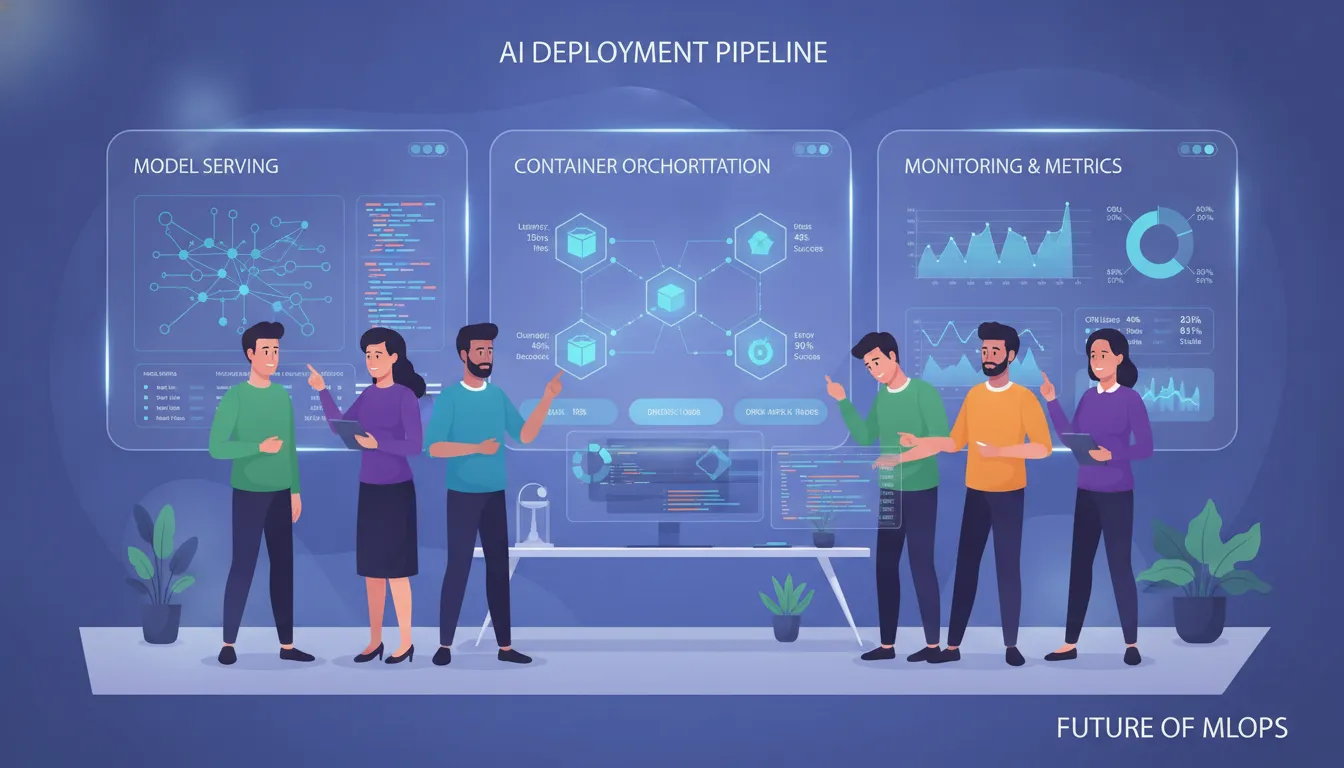
Evaluating candidates for AI implementation engineer roles requires a clear understanding of the modern MLOps and cloud infrastructure ecosystem. A qualified implementation engineer must demonstrate hands-on proficiency across several critical domains, from model serving to distributed orchestration to retrieval architectures.
Deep Learning and Transformer Frameworks
Implementation engineers must be deeply fluent in PyTorch, which powers over 80 percent of modern AI deployments and is the backbone of the Hugging Face ecosystem. Candidates should demonstrate proficiency with model loading paradigms, tokenization pipelines, and the Hugging Face Transformers library. While they are not expected to train models from scratch, they must understand how to optimize inference paths. Manage device placement (CPU versus GPU), and handle model versioning across staging and production environments.
Model Serving and High-Performance Inference Engines
Production deployment demands specialized serving infrastructure. Look for candidates with hands-on experience in Triton Inference Server, TensorRT, vLLM, and BentoML. These tools enable continuous batching, tensor parallelism, and quantization techniques (FP8, INT4, AWQ) that directly reduce GPU memory footprint and cloud hosting costs. A strong candidate will articulate trade-offs between latency, throughput, and model precision for different deployment scenarios.
Distributed Computing and Container Orchestration
Scaling AI inference beyond a single machine requires distributed systems expertise. Ray is a premium skill for orchestrating distributed ML workloads across clusters, while Kubernetes forms the foundation of modern containerized deployment. Candidates should understand how to deploy ML inference pipelines via KServe, configure auto-scaling policies, manage GPU node pools, and implement rolling updates with zero downtime.
Vector Databases and Retrieval-Augmented Generation
For RAG applications, implementation engineers must manage vector embeddings across production-grade vector databases. Look for familiarity with Pinecone, Milvus, Qdrant, Weaviate, or pgvector. Key evaluation points include chunking strategy design, embedding model selection, hybrid search configuration, and index optimization to maintain sub-100-millisecond retrieval latency at scale.
How to Evaluate AI Implementation Engineer Candidates: A 4-Step Framework
Because the AI recruitment market is saturated with generalist software developers who have only surface-level API experience. CTOs and VPs of Engineering need a structured evaluation process to identify truly production-ready engineers. Use this four-step framework to assess both technical depth and operational readiness.
- Sourcing and Portfolio Audits
Analyze each candidates public GitHub profile and technical portfolio for evidence of real-world deployment patterns, not just personal projects. A production-ready engineer will demonstrate clean Dockerfile conventions, structured API endpoint design, CI/CD configuration files, and MLOps tracking integration (MLflow, Weights and Biases, or similar). Look for repositories with proper README documentation, error handling, and test coverage. - The System Design Interview
Replace abstract algorithmic puzzles with realistic production scenarios. Present a brief like "design a scalable translation service handling 10,000 requests per minute with sub-200-millisecond latency." Evaluate how the candidate structures the model serving layer. Designs caching strategies (Redis, Memcached, or in-memory), selects between GPU and CPU inference routes, and implements fallback models for failover scenarios. - The Production Architecture Interview
Probe deep operational knowledge with targeted questions: When would you choose FP16 quantization over FP32? How do you optimize cold-start latency for serverless GPU deployments? What strategies prevent out-of-memory errors during peak concurrent inference? How do you implement A/B testing for model versions in production? Strong candidates will cite specific tools and real trade-offs rather than abstract principles. - Cultural and Strategic Alignment
Exceptional implementation engineers translate technical complexity into business impact. Evaluate their ability to communicate with non-technical stakeholders, prioritize infrastructure investments against product roadmaps, and make pragmatic build-versus-buy decisions. A candidate who dismisses vendor solutions entirely may lack the cost-consciousness that production engineering demands.
Compensation and Salary Benchmarks for AI Implementation Engineers
The extreme demand for specialized AI implementation talent has created highly competitive compensation structures. Organizations must align their offers with current market benchmarks to attract and retain top candidates. Based on People in AI's proprietary hiring database, here are the average base salary ranges across seniority levels for AI implementation engineer roles in the United States.
| Seniority Level | Base Salary Range | Core Skill Premiums |
|---|---|---|
| Mid-Level AI Engineer | $120,000 - $180,000 | API integration, containerization, Python proficiency. |
| Senior AI Implementation Engineer | $200,000 - $350,000 | vLLM, Triton optimization, advanced RAG, custom Docker builds. |
| Staff/Principal AI Engineer | $300,000 - $500,000 | Ray clusters, GPU optimization, distributed training architectures. |
| Distinguished/Fellow Level | $500,000 - $700,000+ | Enterprise AI infrastructure design, industry-defining patents. |
Total compensation packages typically include equity allocations, signing bonuses, and flexible working arrangements, which can add 20 to 40 percent to the base figure. Candidates with proven expertise in high-performance distributed computing frameworks like Ray and advanced inference optimization often command a 15 to 20 percent salary premium over peers who focus solely on API integration. For context on structuring AI team budgets, see our guide on contract versus permanent AI hiring.
Why Partner with People in AI for AI Implementation Engineer Recruitment?
Navigating the specialized market for AI implementation engineer talent requires more than a generic job posting. Generalist recruiting agencies lack the technical depth to evaluate MLOps engineers, evaluate inference optimization expertise. Or distinguish between a candidate who has deployed to production versus one who has only worked on personal projects. This leads to slow hiring cycles and mismatched placements that cost teams months of lost engineering velocity.
At People in AI, we specialize exclusively in AI, machine learning, and data engineering recruitment across North America. Our senior team, led by founders Sam Jones and Sam Agre, remains directly involved in every search engagement. We combine deep technical fluency with a proprietary network of passive AI professionals who are not visible on traditional job boards. This is how we deliver pre-qualified candidates within 3 days of receiving your job brief, and how we reduce our clients average time-to-hire by 40 percent.
Our practice areas span the full spectrum of AI implementation roles, from mid-level engineers to principal architects specializing in distributed inference at scale. Whether you need a single deployment engineer to operationalize your first LLM application or a full team to build a production MLOps platform. We have the network and the evaluation frameworks to find the right fit. For a broader view of how to structure your engineering organization, explore our guide to building an AI team from the ground up.
Browse our active job board to see the caliber of AI implementation roles we represent, or explore our tailored hiring solutions to build your production AI engineering team today.
Frequently Asked Questions
What does an AI implementation engineer do?
An AI implementation engineer deploys, scales, and manages machine learning models in production environments. Unlike research scientists who train models, implementation engineers focus on containerization, low-latency API development, MLOps monitoring, distributed infrastructure scaling, and integrating AI capabilities into user-facing software products.
Why is PyTorch preferred over TensorFlow for AI implementation?
PyTorch has emerged as the industry leader for modern generative AI and deep learning deployment. Powering over 80 percent of recent research and open-source model libraries on Hugging Face. This dominant ecosystem ensures that inference optimization engines like vLLM, TensorRT, and DeepSpeed prioritize PyTorch-based model weights, giving implementation engineers the best performance and tooling support.
How do you test an AI implementation engineer's system design skills?
Present realistic production scenarios such as designing a scalable architecture for serving large language models at 10,000 requests per minute. Evaluate their decisions on model caching strategies, batching approaches, container orchestration via Kubernetes, API gateway routing for load balancing, and MLOps monitoring frameworks for observability.
What is the typical time-to-hire for an AI implementation engineer?
Traditional generalist recruiting can take 45 to 90 days to secure a qualified AI implementation engineer. By partnering with a specialized boutique agency like People in AI. Organizations can leverage a pre-vetted passive candidate network and reduce that timeline by 40 percent, often securing a qualified hire within weeks rather than months.
What is the salary range for an AI implementation engineer?
Mid-level AI implementation engineers earn $120,000 to $180,000, senior engineers earn $200,000 to $350,000, and staff or principal engineers earn $300,000 to $500,000. Distinguished or fellow-level engineers can command $500,000 to $700,000 or more. Candidates with expertise in Ray, advanced inference optimization, and distributed GPU architectures typically command a 15 to 20 percent premium.


