


Hiring artificial intelligence and machine learning talent is one of the most resource-intensive decisions a technical founder, CTO, or VP of Engineering can make. As organizations strive to build robust machine learning models, implement generative AI solutions, and optimize data infrastructure. The recruitment path often diverges into two distinct directions: bringing on permanent, full-time employees or engaging specialized contract professionals. Choosing the wrong path can lead to delayed project timelines, wasted budget, or a critical gap in organizational capabilities.
Schedule a free consultation with our AI recruitment specialists to evaluate which hiring model fits your technical roadmap and budget. Our experts can help you assess your specific needs within three days.
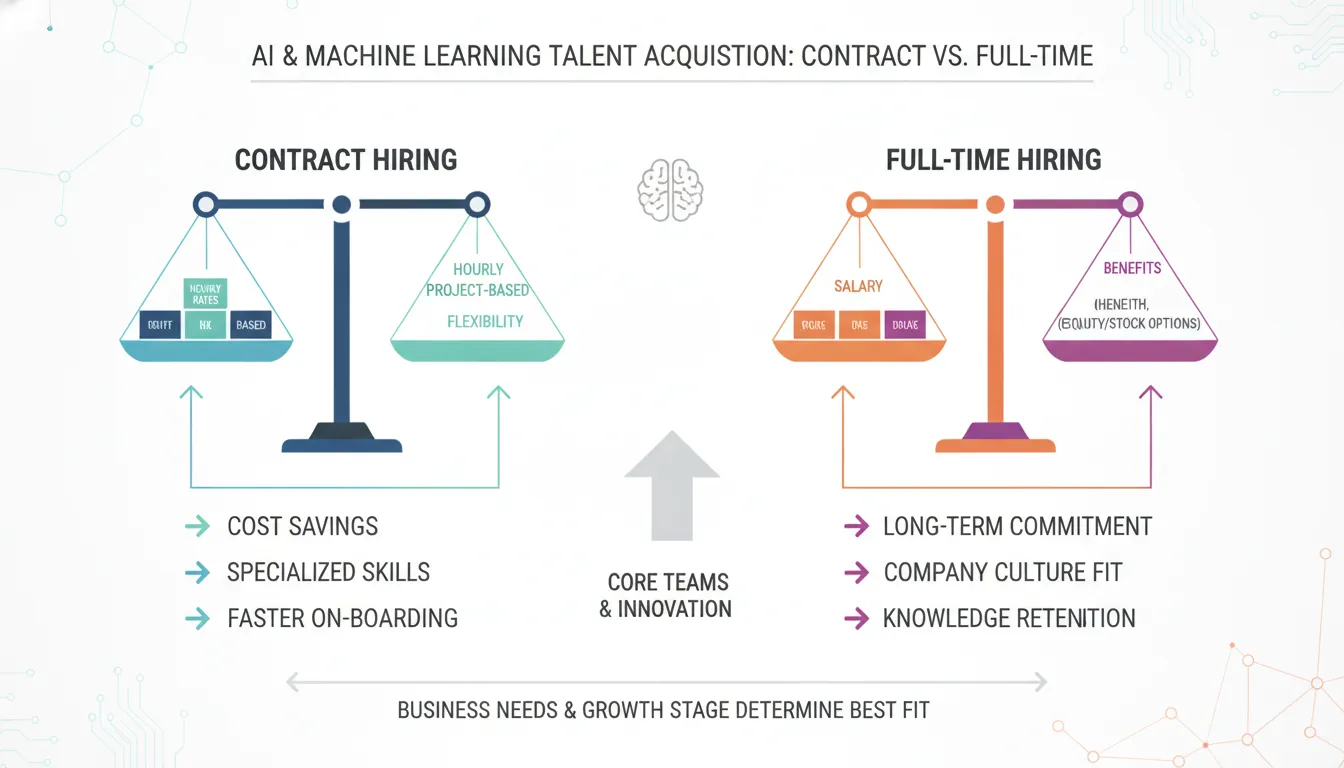
To make the optimal decision, engineering leaders must balance immediate technical needs against long-term roadmap objectives. A consultative approach to talent acquisition requires analyzing loaded cost structures, the lifecycle of AI frameworks, and project-specific risk profiles. Understanding how each employment model integrates with your technical stack and strategic goals is the first step toward building a high-performing AI organization.
The True Financial Equation: Loaded Costs vs. Hourly Rates
Many hiring managers evaluate the choice between contract and full-time hiring solely on base salary compared to hourly contract rates. However, this superficial comparison ignores the substantial overhead associated with permanent employees. According to data from the Bureau of Labor Statistics (BLS) released in late 2025. Benefits account for 29.9% of total compensation for private-industry workers, with the remainder allocated to wages. When payroll taxes, recruiting fees, equipment, and administrative overhead are factored in, the loaded cost of a permanent hire becomes significantly higher.
For example, a senior machine learning engineer in a US tech hub like San Francisco or New York commands a base salary of $200,000. When applying the 29.9% BLS benefits factor along with mandatory taxes and onboarding expenses, the true annual cost of that engineer lands between $250,000 and $260,000. This 1.3x multiplier is a standard benchmark that organizations must calculate when planning budgets. For specialized AI roles such as LLM engineers or MLOps specialists, the multiplier can climb even higher due to equity compensation packages that top AI companies routinely offer.
Contract AI talent, on the other hand, typically commands higher hourly rates. Often ranging from $150 to $250 per hour depending on their specialization in fields like natural language processing (NLP) or MLOps. While this translates to a high apparent run rate, the contractor model eliminates long-term financial commitments, health insurance contributions, equity dilution, and severance packages. For short-term projects or specialized implementations, contract models are highly cost-efficient because you only pay for active development hours. A three-month engagement with a senior NLP engineer at $200 per hour costs roughly $96,000. Compared to over $62,500 in annual fixed costs for a permanent hire before any work begins.
When Should You Choose Contract AI Talent?
Engaging contract AI professionals is highly effective under specific operational scenarios. Organizations should prioritize contract recruitment when the following conditions are met:
- Accelerated Project Timelines: When project delivery dates are fixed and internal resources are fully allocated, contractors provide immediate bandwidth. Specialized agencies like People In AI can deliver qualified candidates within three days, enabling teams to scale rapidly without delaying key milestones.
- Temporary Skill Gaps: If your team is proficient in software engineering but lacks specific machine learning expertise for a single phase of development, a contractor can bridge the gap. Once the architecture is built and documented, your permanent staff can take over daily operations. This pattern is especially common with specialized technologies like vector databases (Pinecone, Weaviate) or distributed training frameworks (PyTorch DDP, Horovod) that require narrow expertise for initial setup.
- Budget Flexibility: Startups scaling from Series A to Series C often need to demonstrate technical progress to investors before committing to permanent payroll expansion. The AI staff augmentation model allows these companies to leverage premium talent while preserving capital and minimizing equity dilution.
- Proof-of-Concept Validation: Before building a dedicated AI division, companies frequently build low-risk prototypes to test feasibility. Contracting an engineer to build a proof-of-concept prevents over-hiring for an unverified product line. A contract computer vision engineer can validate whether your defect detection pipeline works before you commit to a full team.
- Migrations and Infrastructure Overhauls: When transitioning from legacy ML infrastructure to modern MLOps toolchains, contract specialists with specific platform experience can execute migrations faster than teams learning the new stack incrementally.

When Does Full-Time AI Hiring Make More Sense?
Building a permanent AI team is a foundational investment. Full-time hiring is the superior choice for organizations focused on the following strategic goals:
- Core Intellectual Property Development: If your primary value proposition relies on proprietary algorithms and custom-trained models, that code must be developed by permanent employees. This safeguards your intellectual property and ensures the creators remain with the company to maintain it. Companies building proprietary foundation models or domain-specific fine-tuned architectures particularly benefit from permanent research teams who can iterate over multi-year timelines.
- Long-Term Strategic Alignment: AI initiatives are rarely static; they require continuous monitoring, evaluation, and iteration. Permanent employees are aligned with long-term business goals, enabling them to adapt models as market demands shift. A full-time ML engineer who has owned your recommendation system for two years understands its failure modes. Data drift patterns, and business context in ways a contractor never could.
- Institutional Data Security: Working with sensitive enterprise data requires strict adherence to security protocols and compliance standards. Full-time employees undergo thorough screening and integration into internal security cultures, reducing the risks associated with external access to proprietary datasets. For organizations handling protected health information (PHI) or financial data under HIPAA or SOC 2, permanent staff who maintain ongoing security training represent a lower compliance risk profile.
- Sustainable Team Velocity: While contractors excel at rapid deployment, relying on them exclusively can lead to a fragmented codebase and knowledge loss when their contracts end. A dedicated permanent team ensures consistent coding standards, comprehensive documentation practices, and stable development velocity over time. This continuity becomes critical when your production ML systems require 24/7 monitoring and rapid incident response.
- Culture and Knowledge Retention: Full-time employees accumulate deep institutional knowledge about your data assets, customer behavior patterns, and business logic. This tacit knowledge, built up over months and years, directly translates to better model performance and faster iteration cycles. Contractors cycling through may deliver excellent code, but leaving with context that then has to be re-acquired by the next hire.
Evaluating the Skill Lifecycle and AI Toolchains
The pace of innovation in artificial intelligence is unprecedented. Toolchains, frameworks, and model architectures evolve over months rather than years. An organization building a proprietary model might require highly specialized skills in Hugging Face transformers. PyTorch optimization, or vector databases like Pinecone today, but those specific needs may shift as the platform stabilizes.
This rapid shift highlights the concept of the AI skill lifecycle. When a company needs to execute a highly specialized, short-term technical phase (such as setting up an enterprise-grade MLOps pipeline using Kubernetes and Kubeflow). Bringing in a contract specialist is often the most strategic move. Contract professionals bring diverse experience from multiple environments, having executed similar setups across various industries. This broad exposure allows them to deploy solutions rapidly without the learning curve associated with permanent staff.
Conversely, core product development, proprietary IP creation, and continuous model fine-tuning require deep contextual knowledge of the company data assets and business logic. Full-time employees are uniquely positioned to manage these long-term roadmaps. They foster institutional knowledge, align with company culture, and maintain long-term ownership of the codebase. When the technical objective requires sustaining a platform over several years, investing in permanent talent ensures stability and consistent stewardship of your AI architecture.
A practical example: a fintech company building a fraud detection system might hire a contract MLOps engineer to set up the feature store. Model registry, and deployment pipeline using Feast and MLflow over a four-month period. Once infrastructure is established, the same company would hire a permanent ML engineer to continuously train and deploy improved models against evolving fraud patterns. Leveraging the infrastructure the contractor built.
How Do You Mitigate Recruitment Risks in Both Models?
Regardless of the model you select, recruiting specialized AI talent carries inherent risks. Technical screening is complex, and the cost of a bad hire is exceptionally high, particularly in early-stage startups or specialized enterprise units. For permanent roles, a bad hire can disrupt team dynamics and cost up to double the employee annual salary in lost productivity and recruitment costs.
To mitigate these risks, organizations must adopt rigorous verification processes. When pursuing permanent placements, partnering with a specialized firm that offers protective safeguards (such as a 90-day replacement guarantee) provides vital financial security. For contract engagements, using a partner that manages compliance, payroll. And background screening ensures that your external workforce remains fully compliant with local labor laws without adding administrative burdens to your HR department.
Key risk mitigation strategies include:
- Technical deep dives: Move beyond resume screening to hands-on technical assessments that evaluate actual coding ability, system design thinking, and ML fundamentals. Contractors should complete a paid trial task before full commitment.
- Reference verification on similar projects: For contractors, verify that they have successfully delivered comparable projects at similar scale. A contractor who fine-tuned BERT for a medical NLP startup may not be the right fit for a large-scale distributed training pipeline.
- Structured onboarding regardless of model: Even experienced contractors need a structured first week that covers data access, codebase navigation, and team communication norms. This investment pays back in reduced ramp-up time.
- Knowledge documentation as a contractual requirement: For contract engagements, include knowledge transfer and documentation deliverables in the statement of work. This ensures critical context survives the engagement.
A strategic partner can streamline this process significantly. By maintaining an active network of thoroughly vetted candidates, specialized recruiters can reduce the typical hiring cycle by up to 40%. Ensuring you secure top-tier talent before they accept competing offers in a highly competitive market.
A Strategic Framework for Decision Makers
To determine the best fit for your current business objectives, consider this three-part decision framework:
- Define the Horizon: Is this initiative a discrete project with a clear end date (e.g., migrating data pipelines or integrating a specific API), or is it an ongoing core product capability? Discrete projects favor contract models; ongoing capabilities demand permanent staff.
- Analyze the Toolchain: Does the task require deep knowledge of proprietary systems and custom datasets, or does it involve deploying standard industry frameworks and MLOps practices? Standard frameworks can be rapidly deployed by specialized contractors, while proprietary systems benefit from the long-term focus of full-time engineers.
- Assess Team Bandwidth: Do you have the internal leadership capacity to guide, onboard, and manage a new permanent employee? If your management team is already stretched thin, bringing on a self-starting contractor who requires minimal oversight can keep projects moving without overwhelming your existing leadership.
For a comprehensive guide on sourcing and evaluating permanent technical professionals, explore our resource on hiring strategies for AI engineering. If you are exploring flexible, project-based scaling options, read about our specialized AI staffing partner solutions to find the model that aligns with your timeline. You may also find our guide to hiring ML engineers useful for understanding the specific technical evaluation criteria for each engagement model.
Frequently Asked Questions About Contract vs Full-Time AI Hiring
How much does a contract AI engineer cost compared to a full-time employee?
A contract senior AI engineer typically charges $150 to $250 per hour, while a full-time equivalent commands a $180,000 to $220,000 base salary plus 29.9% in benefits costs. For a six-month engagement, a contractor may cost $144,000 to $240,000 total. While a full-time employee costs $117,000 to $143,000 in salary and benefits alone, excluding severance and recruiting fees. The breakeven point generally falls between 9 and 14 months of continuous work.
Can contract AI talent transition to full-time roles?
Yes. Many organizations use contract engagements as extended evaluations before making permanent offers. This contract-to-hire model lets both the employer and the candidate assess technical fit, cultural alignment, and working style before committing to a permanent arrangement. It is particularly common in AI roles where hands-on technical evaluation is the most reliable indicator of long-term success.
What types of AI projects are best suited for contract workers?
Contract workers excel at projects with clear scope and defined deliverables: MLOps pipeline setup, data infrastructure migration. Proof-of-concept development, model evaluation and benchmarking, API integration, and specialized implementation of specific frameworks like RAG architectures or fine-tuning pipelines. Projects that benefit from prior experience across multiple organizations also favor contractors, as they bring battle-tested patterns from various industry contexts.
How quickly can I hire a contract AI specialist?
Specialized AI recruitment agencies like People In AI can deliver qualified contract candidates within three business days of receiving a detailed job brief. This rapid turnaround is made possible through actively maintained networks of pre-vetted passive candidates and deep specialization in AI/ML roles. Typical time-to-offer ranges from one to three weeks depending on interview availability and candidate evaluation requirements.
What are the hidden costs of full-time AI hires?
Beyond base salary and the 29.9% BLS benefits factor. Full-time AI hires carry costs including equity compensation (a major factor at early-stage and high-growth companies), recruitment agency fees of 15-25% of first-year salary. Onboarding and ramp-up time (3-6 months for full productivity), ongoing training and conference budgets. Hardware and cloud compute credits, and severance costs if the role does not work out. These hidden costs can add 40-60% above base salary in the first year.
Do contract AI engineers get equity or benefits?
Contract AI engineers generally do not receive equity or employee benefits. Their compensation is strictly based on their hourly or project rate, which is higher to compensate for the absence of benefits, paid time off, and long-term incentives. Some contract-to-hire arrangements may include provisions for converting to full-time status with equity and benefits after an agreed period, typically three to six months.
How do I evaluate an AI contractor's technical skills?
Evaluate AI contractors through a combination of portfolio review (previous projects, GitHub repositories, published work), paid technical assessments tailored to your specific stack. System design interviews focused on ML architecture decisions, reference checks with previous clients on similar projects, and a short paid trial task that mirrors actual work. Look for evidence of production deployments, not just experimental or academic projects, as the gap between notebook code and production ML systems is substantial.
When does it make sense to use both contract and full-time AI staff together?
A blended model is often the most effective approach. A permanent core team handles strategic direction, proprietary development, and system ownership. While contract specialists fill specific expertise gaps for discrete phases such as infrastructure setup, specialized model training, performance optimization, or platform migrations. This hybrid approach gives organizations the stability of institutional knowledge with the flexibility to access niche expertise on demand. Many of our clients maintain a 60-40 or 70-30 split between permanent and contract AI talent.
Ready to Build Your AI Team?
Whether you need to scale your team with a permanent senior researcher or deploy an expert contractor within three days. Having founder-level attention on your search ensures your technical bar remains exceptionally high. Our AI recruitment specialists bring over a decade of focused AI/ML recruiting experience to every engagement, delivering pre-vetted candidates who meet your exact technical requirements.
Contact our executive team today to discuss your specific technical requirements. We offer a 90-day replacement guarantee on permanent placements and full compliance management for contract engagements, ensuring your hiring process moves forward with confidence.


