


Computer vision engineer hiring is no longer about finding a generalist who can use a camera. Today, the field needs a focus on robotics, medical tests, or self-driving systems. Success depends on finding people who can move models into real-time production.
Get started with People In AI hiring solutions — we deliver vetted computer vision engineer candidates in just 3 days.
Computer vision engineer hiring is a top goal for teams building self-driving systems, robotics, and medical tests. As the Stanford 2025 AI Index Report highlights, these roles are now among the defining jobs in the AI field. To hire well, you must look for engineers who know tools like OpenCV and PyTorch, but also know how to handle messy data. The process starts with a clear look at your needs, such as object detection. You should check candidates based on their work with live systems rather than just their research papers or scores. By testing their ability to solve odd cases in production, you make sure the talent can get results. A strong hire will bridge the gap between research and software that works in the field.
Finding the right person for your team requires knowing exactly which sub-field you want. You need to see how a candidate's specific skills fit your goals. We will look at how Computer Vision Engineering Has Split Into Three Distinct Tracks to help you narrow your search. Here is how the market is changing.
Computer Vision Engineer Hiring: Computer Vision Engineering Has Split Into Three Distinct Tracks
The field of computer vision has grown fast. It is no longer just one job. The Stanford 2025 AI Index Report calls the computer vision engineer a defining job for this era. But for computer vision and robotics recruitment, you must know that the role has split. There are now three main paths. Each one needs its own set of skills. You cannot hire for one and expect them to do the other jobs well.
Self-Driving and Perception
This track is about how machines move in the real world. These engineers build systems for self-driving cars, drones, and robots. They use data from cameras, radar, and lidar to map the world. The goal is to help a machine see its path and avoid risks in real time. They often work with live video feeds and must make choices in a split second.
When you look for talent in this track, seek out those with a strong base in 3D math. They must know how to join data from many sensors at once. Most work in C++ to keep the system fast. They also need to handle edge cases where the machine might get lost or confused. Top hires often come from robotics labs or have worked on large drone fleets.
Healthcare and Medical Imaging
Medical vision is a field where small errors matter. In this space, computer vision systems study brain scans to find tumors or signs of disease. These tools can now find lung issues as well as a human doctor. These roles need a deep grasp of 3D data from CT or MRI machines. The work helps doctors plan how to treat patients with more care.
Hiring here needs experts who know how to work with high-quality images. These images often have more detail than a normal photo. Engineers must also know how to make tools that follow strict laws. A doctor needs to trust what the tool shows them. You should look for those who have worked with medical data sets and understand 3D mapping.
Industrial and Embedded Vision
Industrial vision keeps the world's factories running. It uses cameras to find tiny cracks or flaws in parts on a fast belt. These engineers often work with small devices that have very little power. They must fit large AI models into tiny chips that live on the factory floor. This needs a mix of AI skills and hardware knowledge.
If you need a founder guide to AI hiring for hardware, this is your target. The focus here is on speed and low cost for mass production. These engineers use tools to shrink models so they run fast without the cloud. They must also know how to deal with the harsh light and dust of a real factory floor.
| Track | Primary Stack | Comp Range | Key Frameworks | Portfolio Signals |
|---|---|---|---|---|
| Perception and AV | C++, Python, CUDA | $290K to $410K | SLAM, ROS, PyTorch | Real-time object tracking |
| Medical Imaging | Python, C++, Julia | $290K to $410K | MONAI, ITK, VTK | 3D medical mapping |
| Industrial Vision | C, C++, Python | $145K to $275K | OpenCV, OpenVINO | Edge AI and model shrinking |
Each of these tracks has its own market. The pay for a top expert in self-driving cars can be much higher than for a general role. When you start your search, be clear about which track you need. This will help you find the right talent faster and avoid missing out on the best hires.
What Technical Skills Should You Evaluate in Computer Vision Candidates?
Hiring for computer vision roles is hard because the field moves so fast. The Stanford 2025 AI Index Report lists computer vision engineer as a key role in the AI market today. To find the right fit, you must look past simple buzzwords. You need to test for depth in core tools and the skill to use new models that save time.
Mastery of Core Frameworks and Math
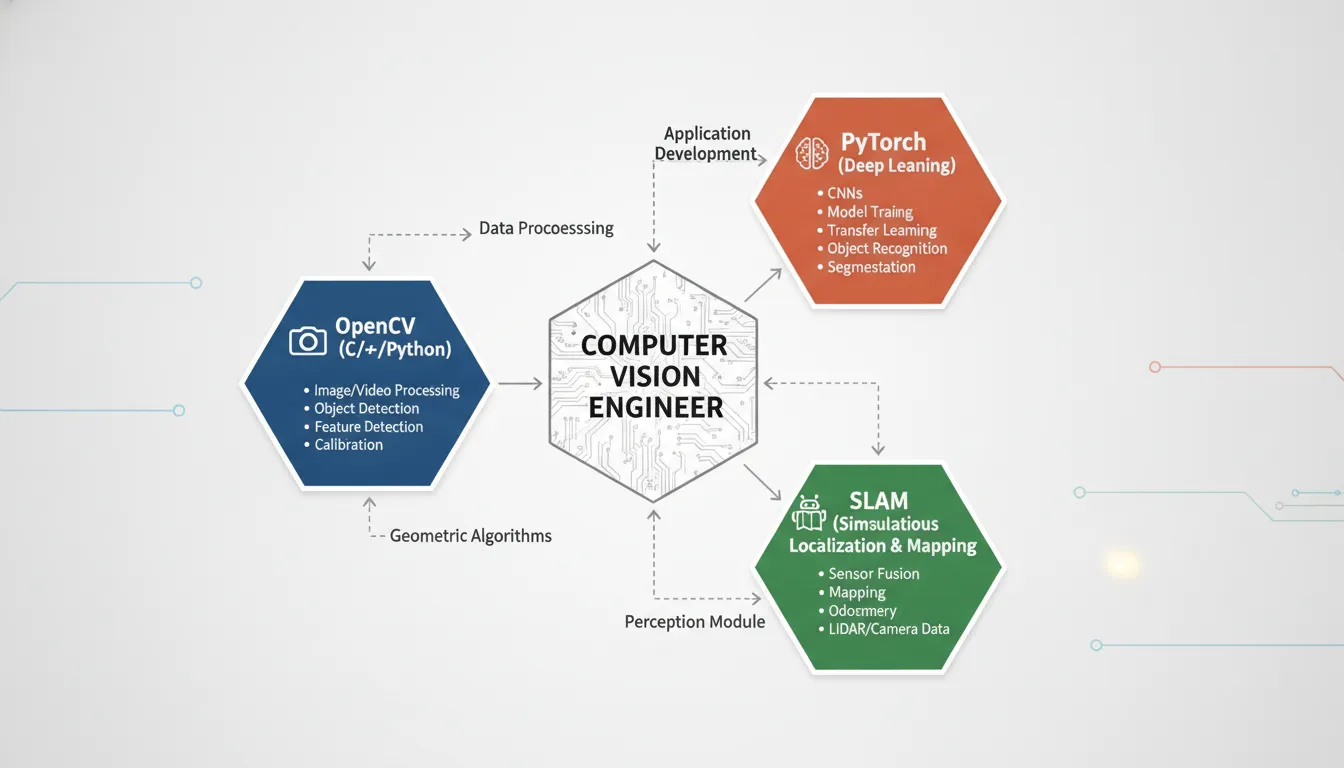
A strong candidate needs more than a basic grasp of Python. They should show deep skill in tools like OpenCV for image work. Most teams also need experts in PyTorch or TensorFlow for deep learning. You should ask how they handle image data before it hits a model. This includes skills in filtering, scaling, and color space changes.
Math skill is just as vital. Candidates must understand linear algebra and calculus to fix training runs. If they work on robotics, they need to know Simultaneous Localization and Mapping (SLAM). These skills allow robots to build maps of new areas while tracking where they are. You can find more details in our computer vision engineer career guide to see how these skills map to job levels.
Object Detection and Segmentation Architectures
You should check their work with specific model types. Most live systems rely on tools like YOLO for fast object detection. Newer teams are now moving toward foundation models. For example, Segment Anything Model 2 (SAM 2) has changed how we handle mask work. One engineer reported that SAM 2 helped them cut annotation time from three months down to just two weeks.
Candidates should also know about depth estimation and 3D work. These are key for fields like self-driving cars or medical tech. In health care, computer vision tools help doctors analyze brain scans to find tumors or signs of disease. A top hire will know which model fits your data type and hardware limits.
Practical Production Knowledge
The best engineers know that code in a notebook is not the same as code in the real world. They should know how to shrink models to run on small devices using tools like TensorRT. They also need to know MLOps. This includes tracking data versions and checking how a model performs after it goes live. Ask them how they handle "data drift" when real-world images start to look different from the training set.
Finally, look for a background in testing. A good engineer writes tests for their data pipes as well as their model code. They should be able to explain why they chose a specific metric to measure success. Testing for these skills ensures your new hire can build tools that work in a real setup, not just in a lab.
How the Foundation-Model Pivot Reshaped Computer Vision Hiring
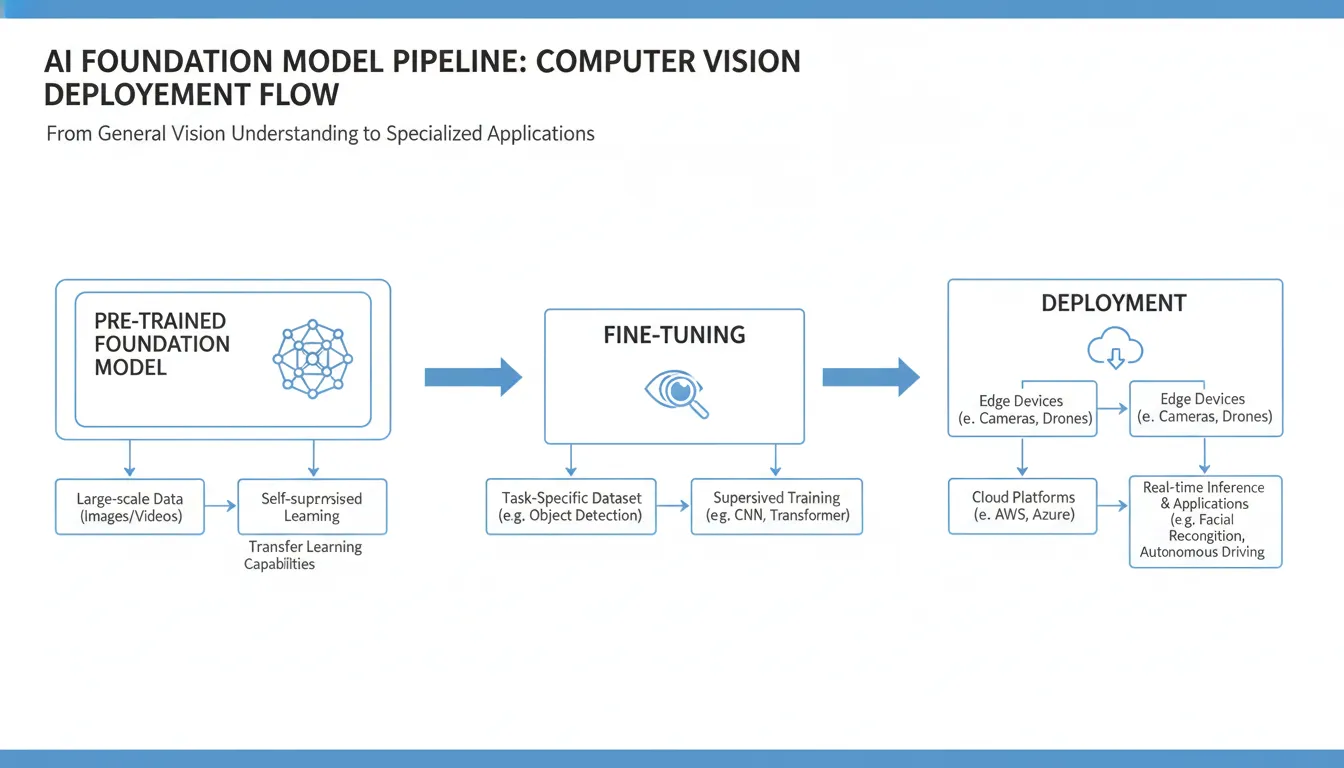
The role of the computer vision engineer is not what it was two years ago. In the past, the job was built on custom work. An engineer would spend most of their time labeling data and training small models from scratch. Today, a foundation-model pivot has changed the entire field. This shift has forced hiring leads to update their skill lists and test loops.
Modern teams no longer look for people who just know how to build a basic model. They want experts who can use large, pre-trained bases to solve hard problems fast. This change makes the hiring process more about speed and tuning. It moves the focus away from the old ways of hand data prep and slow model training.
The End of the Hand Labeling Era
For a long time, hand data work was the core of the role. Engineers spent months labeling images for each new project. New models like SAM 2 and DINOv2 have ended that era. These tools can find and segment objects with very little human help. This shift has deleted about half of the labeling work that once anchored the job.
The impact on speed is huge. In one case, a project that took three months of annotation work was done in two weeks using SAM 2. The engineer used the base model and a simple classifier to hit production accuracy. When you look for specialized computer vision engineer skills today, the power to use these fast paths is a top goal. Hiring leads now prize this speed over the power to build custom pipelines from zero.
New Benchmarks for Technical Test Loops
The old test loop is dying. It used to test if a person could build convolutional neural networks for specific tasks. People spent hours showing how they would handle loss and over-fitting. Today, those skills are less useful for most business tasks. The new loop tests how a person uses zero-shot prompting and fine-tuning.
Hiring teams now look for knowledge of models like Florence-2 and Grounding DINO. These act as the new baseline for computer vision work. A top hire should show they can take a broad model and make it work for a niche use case. They must know when to use a base model as-is and when to add a custom head. This requires a deep knowledge of how these big models behave in the real world.
Why Model Adaptation Trumps Model Training
The goal is no longer to be the best model trainer. Instead, the best hires are the best at model tuning. They can pick the right base for a task and tune it for high accuracy. This shift has made the role more about systems engineering than pure data science. It also means that a candidate's portfolio should show more than just high scores on common datasets like ImageNet.
Look for engineers who talk about deployment and cost. A good hire knows that using a foundation model is often cheaper and better than building a custom one. They know how to trade off model size for speed. They also know how to keep a system running when the data changes. These are the skills that define the next group of computer vision talent.
The market has moved past the days of slow, custom builds. Hiring the right person means finding someone who lives in this new world of foundation models. They should be able to show how they have used these tools to cut down on dev time. If they are still focused on the old loop, they may not be the right fit for a modern AI team.
How to Evaluate a Computer Vision Engineer's Portfolio
Hiring a computer vision engineer requires looking past a long list of accuracy scores. A strong portfolio should show how a candidate handles the messiness of the real world. You want to see that they can build systems that work in production, not just in a lab. Use these five steps to find the best talent for your team.
Check for production deployment experience
Top candidates show more than just high scores on public data sets. Look for projects where the engineer took a model from a notebook to a live environment. They should be able to discuss how they managed detection or segmentation architectures in a real product. This shows they understand how to use hiring specialized technical talent methods to solve actual business needs.
Assess real-world data handling
Building a model is easy when the data is clean, but real images have noise, blur, and bad lighting. A skilled engineer will talk about the pain of preprocessing and data cleaning. They should show work that involves fixing image quality issues before training a model. According to the the Stanford 2025 AI Index Report, computer vision is now a defining AI role, making these practical skills more valuable than ever.
Look for video and stereo experience
Many vision tasks move beyond still photos. If your role involves motion or depth, check for experience with video streams or stereo cameras. An engineer who can handle temporal data knows how to deal with frame rates and tracking over time. This expertise is a key signal when you are recruiting for computer vision and robotics roles that require high-speed perception.
- Verify deployment history. Seek evidence of models running in production apps rather than just research papers or simple school projects.
- Inspect data pipelines. Ask how they handled missing labels or noisy inputs, as this reveals their true engineering grit and problem-solving ability.
- Test for failure-mode awareness. A good engineer knows when their model will fail and builds ways to catch those errors before they reach the user.
- Review GitHub for code quality. Look for clean, modular code and good documentation that shows they can work well with the rest of your engineering team.
- Check for video fluency. Make sure they can work with live video feeds if your product needs to track objects or people in real time.
A portfolio that focuses on deployment and data handling is a clear win. It shows the engineer can handle the hard parts of the job. By following these steps, you can filter out the noise and find a partner who will help your company grow.
What Are the Salary Benchmarks and Hiring Timelines for Computer Vision Engineers?
Finding the right talent means knowing the current market rates. Pay for computer vision engineers varies by their level of skill and their chosen field. In the United States, mid-level engineers often earn between $145,000 and $190,000. Senior roles see a jump to the $200,000 to $275,000 range. These figures are for base pay and often do not include extra pay or stock. For high-growth startups, equity packages can add a lot of value to the total offer.
Pay scales by industry and experience
Some industries pay a heavy premium for expert skills. Experts in autonomous driving perception and medical imaging often clear $290,000 to $410,000 in total pay. These roles need deep knowledge of safety-critical systems and strict rules. For example, medical imaging roles often demand work with computer-aided diagnosis and FDA approval paths. These high-stakes fields have a higher bar for entry than general computer vision work.
In contrast, industrial machine-vision roles often sit at the lower end of the pay scale. These roles usually focus on factory auto tasks or quality control for goods. While the work is vital, the pool of people is larger. This leads to more modest pay compared to the AV or medical sectors. If your firm needs to hire for these roles, you should look for specialized computer vision engineer skills that match your exact factory needs.
Regional premiums and remote work trends
Place still plays a major role in how much engineers earn. Tech hubs like San Francisco, New York City, Seattle, and Boston command the highest rates. Companies in these cities often pay 15% to 25% more than the national average. This helps workers deal with the high cost of living in these areas. Local demand for AI talent in these cities stays very high even as other sectors slow down.
But the rise of remote work has shifted this in a big way. Many firms now offer wide pay bands to win top talent no matter where they live. A developer in a smaller city can now earn a Silicon Valley wage if they have the right niche skills. This change has made the market much more tough for local firms. To win, you must be ready to offer flexible work terms or a very strong brand mission.
Expected hiring windows for AI talent
The time it takes to fill a role depends on the technical bar you set. Most standard searches for computer vision talent close within four to nine weeks. This time includes the first outreach, technical tests, and final rounds. If you need a specialist in AV perception or FDA-regulated imaging, expect a wait of about 12 weeks. These niche roles have a smaller pool of people who fit the work.
Using a firm that focuses on recruiting for computer vision and robotics can help speed up the process. We use our deep network to find passive talent that is not active on job boards. Remote-first roles also tend to move faster. Some teams can fill these positions in just seven to 14 days because they can pull from a global talent pool. Being fast is a huge edge when you are competing for the best AI talent in the world.
Where to Find Hidden Computer Vision Talent
Most hiring teams start and end their search on job boards. But the best talent is often found in niche tech hubs. Finding a top candidate for your team needs a deeper look into where builders share their work. You can find high-level engineers on sites like Papers with Code or Hugging Face. These sites show you real code and project results before you even talk to a lead.
Tech hubs and group sites
Papers with Code is a great place to spot talent. It connects research papers to the code that runs them. You can see who is pushing the state of the art in object detection or segmentation. Hugging Face is also a core spot for the computer vision world. It hosts many models that engineers use to build new tools. Looking at these sites helps you find people who are active in the field.
Robotics Discord servers and Slack groups are also good for computer vision engineer hiring. These private spots are where engineers talk about hard bugs and new hardware. To hire well, you must meet them where they work. Using our founder guide to AI hiring can help you build these paths. It shows how to connect with experts in a way that feels right to them.
Research labs and major events
Top engineers often come from elite college labs. Groups at schools like Stanford or MIT lead the way in new vision tech. You should also track the papers from major events like CVPR and ICCV. These meets are where the best minds show their new ideas. Many authors are ready for roles where they can apply their research to real products.
Looking at these papers shows the impact of their work. As one case, systems can now find lung nodules in chest scans as well as expert doctors can. These high-stakes wins prove that the right talent can solve very hard problems. By reading the list of authors, you find people who know how to build tools that matter. These pros often want to move from labs to fast-paced teams.
Passive networks and boutique search
Many of the best engineers do not look for new jobs. They are busy building at their current firms. To find them, you need a passive search plan. This means reaching out to people who are not on the market. You must show them a role that is a step up for their career. This work takes time and deep know-how of the vision field.
At People in AI, we know these hidden networks. We use our niche focus to find the best talent fast. We offer a 3-day candidate delivery promise to help you scale. Our team looks past the resume to find the real skill in every candidate. We help you skip the noise and get right to the people who can ship code. This approach saves you time and leads to better hires for your AI team.
Frequently Asked Questions
Are computer vision engineers in demand?
According to the Stanford 2025 AI Index Report, computer vision engineering is a defining AI occupation. Companies across robotics, medical imaging, and autonomous systems need these experts to build models that can see and act. High demand from both tech giants and startups makes this one of the hardest roles to fill in the current market. Specialized hiring help is often needed to find top talent in this niche field.
What is the typical salary for a computer vision engineer?
Recent data from industry benchmarks shows that mid-level engineers in the US earn between $145,000 and $190,000. Senior professionals often see pay from $200,000 to $275,000. Specialists in fields like medical imaging or autonomous driving can earn more than $400,000 in total pay. These high rates reflect the deep technical skills and years of experience needed to build production-grade vision systems for complex, real-world tasks.
How has the foundation-model pivot changed the computer vision engineer role?
The role has shifted from manual data labeling to using large, pre-trained models. For example, using models like SAM 2 can cut development time from months to weeks. Instead of building every part from scratch, engineers now focus on fine-tuning and model deployment. This change allows teams to ship products faster and solve harder problems. Engineers now need more skills in model adaptation and less time spent on the basic task of marking images.
What specific skills should I evaluate in a computer vision engineer?
You should check for a mix of math, deep learning, and software skills. Key tools often include OpenCV, PyTorch, and TensorFlow. Good candidates should show they can handle messy, real-world data and not just clean datasets. At People in AI, we vet talent through GitHub reviews and real-world simulations. Look for those who have moved models into production and can explain how they dealt with edge cases in live environments.
How long does it take to hire a computer vision engineer?
Most searches for these specialists take between four and nine weeks to close. The time depends on how niche the requirements are and how fast your team can move. Roles that need local presence or rare skills like SLAM can take more time. Using a partner who focuses only on AI can help you find and vet candidates in days instead of months. Speed is key because top engineers usually have many job offers at once.
Ready to hire an expert computer vision engineer?
Every day your key roles stay empty is a day your tech falls behind. In a tight market, you cannot wait to find the right person. Top talent will not stay open for long. If you wait, you risk losing the best engineers to your rivals. This delay can stall your build and cost you much more in the long run.
Explore our hiring solutions — we deliver vetted computer vision engineer candidates in just 3 days.
Ready to hire? Contact People in AI to book a call for expert computer vision hiring.


