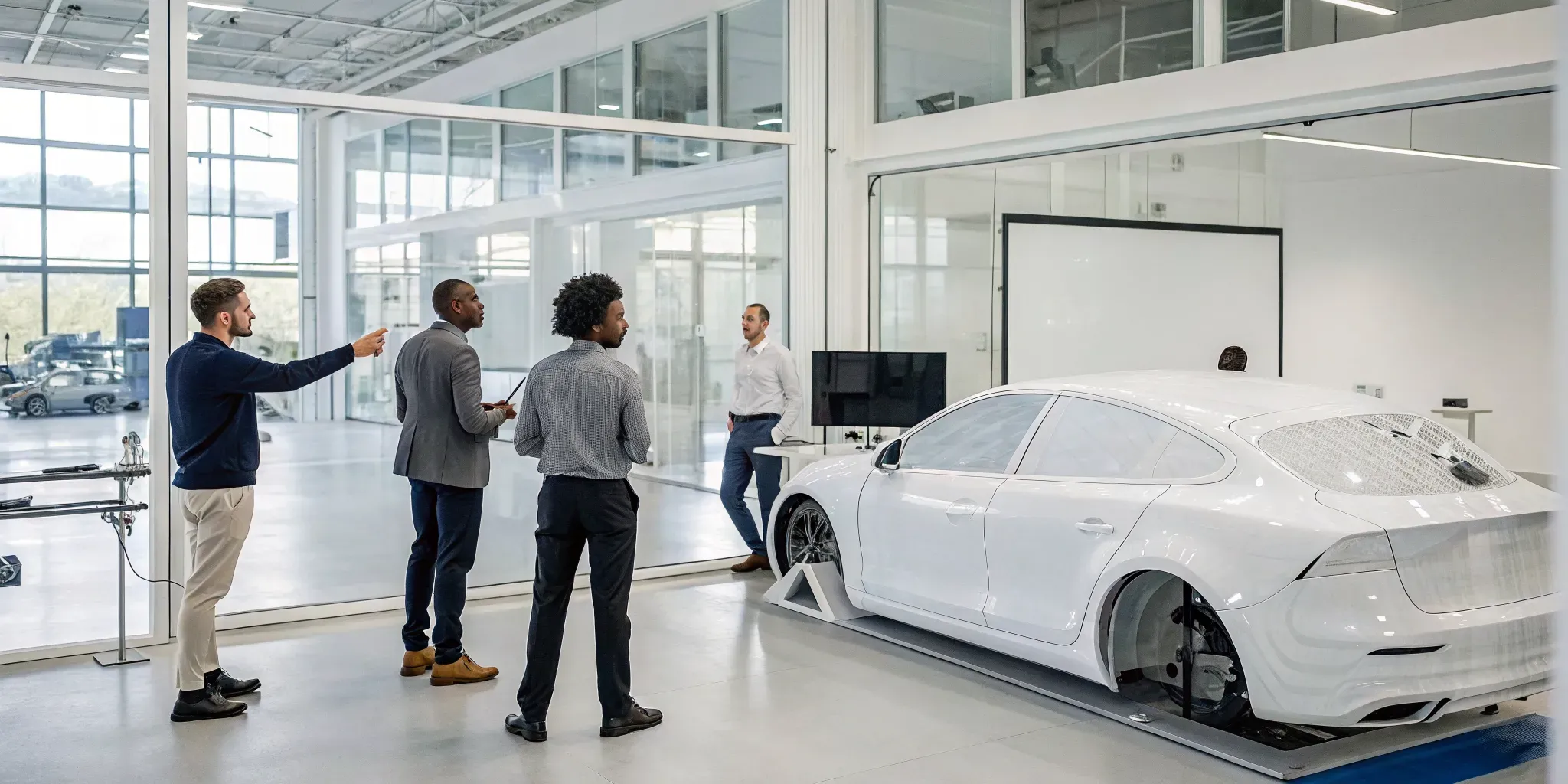
Teaching a car to drive is one of the greatest technological challenges of our time. It’s not just about programming a set of rules; it’s about creating an intelligence that can handle the infinite unpredictability of the open road. This is where the AI engineer comes in. They are the architects of the vehicle’s brain, designing the neural networks that interpret sensor data and the algorithms that make critical, split-second decisions. Their job is to turn terabytes of raw data into a system that can safely identify a pedestrian in the rain or predict another driver’s next move. For companies and candidates alike, understanding the unique demands placed on **AI engineers for autonomous vehicles** is the first step to building or joining a world-class team.
## Key Takeaways
* **Master both algorithm development and data handling**: An AI engineer's role goes beyond just coding; it involves designing the core perception and decision-making algorithms while also managing the massive data pipelines required to train and validate the vehicle's AI.
* **Combine technical expertise with strong collaborative skills**: While proficiency in Python, C++, and machine learning is crucial, your success depends on your ability to communicate clearly and work effectively with hardware, safety, and systems teams to integrate the technology safely.
* **[Explore a wide range of career opportunities](https://www.peopleinai.com/job/ai-engineer-3)**: The demand for talent is high across the industry, with specialized roles available at established automakers, tech giants, and innovative startups, each offering unique challenges and paths for career growth.
## What Does an AI Engineer Do on a Self-Driving Car Team?
When you think about self-driving cars, it’s easy to picture a futuristic vehicle gliding smoothly through traffic. But behind that seamless experience is a team of brilliant AI engineers solving some of the most complex problems in technology today. Their job is to essentially teach a car how to see, think, and react like an expert driver, but with the precision and reliability of a machine. It’s a role that blends cutting-edge research with practical, real-world application.
An [AI Engineer](https://www.peopleinai.com/areas?area=ai-engineering) on an autonomous vehicle (AV) team doesn’t just write code; they build the car’s brain. They are responsible for designing the neural networks that interpret sensor data, developing the algorithms that plot a safe path forward, and managing the massive datasets required to train these systems. Their work directly impacts how the vehicle perceives its environment, from identifying a pedestrian in the rain to predicting the actions of other drivers. It’s a highly collaborative and iterative process, where every line of code is rigorously tested to meet the highest safety standards. Ultimately, they are the architects of the artificial intelligence that makes autonomous driving possible.
### A Day in the Life: Core Responsibilities
An AI engineer’s day on a self-driving car team is focused on one primary goal: making the vehicle smarter and safer. This involves training sophisticated AI models on enormous datasets, much like how large language models learn from the internet. This training helps the car [understand the world](https://engineering.stanford.edu/news/future-autonomous-vehicles) and handle unpredictable road scenarios it hasn't encountered before. You might spend your morning refining a model that distinguishes a plastic bag from a small animal on the road, and your afternoon analyzing test drive data to identify why the car hesitated at a four-way stop. It’s a constant cycle of development, testing, and refinement to prepare the vehicle for the complexities of real-world driving.
### Developing and Implementing Key Algorithms
At the heart of an AI engineer's work is the development of algorithms that govern the car's core functions. These systems are typically broken down into three main areas. The first is **Perception**, which involves using data from cameras, LiDAR, and radar to help the car "see" and identify objects like other vehicles, cyclists, and traffic signals. The second is **Localization and Mapping**, which allows the car to know its precise location on a map. The third is **Decision Making**, where the AI uses all this information to decide the safest and most efficient action, whether that’s changing lanes, braking, or accelerating. These three systems work together to create a comprehensive understanding of the driving environment.
### Managing and Analyzing Vehicle Data
Self-driving cars are incredible data-generating machines. A single vehicle can produce terabytes of information from its cameras, sensors, and radar during a test drive. A critical part of an AI engineer's role is to manage and process this flood of data. They build robust data pipelines to collect, store, and analyze this information, which is then used for the [AI training and development](https://www.nvidia.com/en-us/solutions/autonomous-vehicles/ai-training/) process. This data is essential for teaching the AI models how to handle countless driving scenarios and edge cases. The engineer’s ability to effectively use this data is what allows the team to continuously improve the vehicle’s performance and ensure it operates safely in the real world.
## Who's Hiring AI Engineers for Self-Driving Cars?
The demand for skilled AI engineers in the autonomous vehicle industry is higher than ever. From legacy automakers retooling their factories for the future to nimble tech startups breaking new ground, the opportunities are widespread and exciting. The hiring landscape is diverse, with different types of companies offering unique challenges and career paths. Understanding who is hiring and what they’re looking for is the first step toward finding your place in this revolutionary field. Whether you're a company building a team or an engineer seeking your next role, knowing the key players is essential.
### How Specialized Recruiters Connect Talent with Top Companies
Making sense of the autonomous vehicle job market can be complex. That’s where specialized recruiters come in. With a deep focus on the automotive sector, these recruiters understand the unique skill sets required for AI engineers in self-driving technology. They act as a bridge, connecting top-tier talent with leading companies and ensuring the right candidates are matched with the industry's growing demand. For engineers, working with a recruiter provides access to exclusive roles and expert career guidance. For companies, it streamlines the hiring process, helping them find professionals with the specific [AI engineering](https://www.peopleinai.com/areas?area=ai-engineering) skills needed to push their technology forward.
### The Big Players: Automakers and Tech Giants
It’s no surprise that major automakers and established tech giants are at the forefront of hiring for autonomous vehicle teams. Companies like GM, Ford, and Tesla, along with tech leaders such as Waymo (Google), Cruise, and Nvidia, are investing billions into their AV programs. These organizations offer the chance to work on large-scale projects with massive datasets and extensive resources. They are actively hiring AI engineers to enhance their autonomous capabilities, blending traditional automotive engineering with cutting-edge AI to set new industry standards. These roles often provide stability and a clear path for career growth within a well-structured corporate environment.
### The Innovators: Startups to Watch
Alongside the industry giants, a vibrant ecosystem of startups is revolutionizing autonomous driving. Companies like Wayve, Zoox, and Aurora are leveraging AI in novel ways, often moving at a rapid pace to solve specific challenges in the field. These innovators attract top talent by offering a dynamic environment where engineers can have a significant impact on a product's direction. The collaboration between established companies and these agile startups creates a rich landscape where AI engineers can thrive. If you're looking for a fast-paced culture and the chance to work on groundbreaking technology from the ground up, you can [find opportunities](https://www.peopleinai.com/jobs) at these exciting companies.
## What Skills Do You Need to Work on Autonomous Vehicles?
Landing a role in the autonomous vehicle industry requires a powerful mix of technical know-how, a solid educational background, and strong collaborative skills. It’s not just about being a great coder; it’s about being a great teammate and problem-solver who can contribute to one of the most complex engineering challenges out there. Let's break down the essential skills you'll need to build a successful career in this field, from the programming languages you should master to the soft skills that will set you apart.
### Must-Have Technical Skills and Languages
At the core, you need a strong command of programming languages like Python and C++, which are the industry standards for developing autonomous systems. Beyond coding, a deep understanding of [Machine Learning](https://www.peopleinai.com/areas?area=machine-learning) is non-negotiable. This is how self-driving cars learn to "see" and "make decisions" on the road. You’ll apply these skills in areas like computer vision for object detection, sensor fusion to combine data from LiDAR and cameras, and path planning algorithms to determine the vehicle's route. AI is what helps these cars understand their surroundings, know their location, and decide what to do next, making these technical skills the foundation of your work.
### Your Educational and Certification Roadmap
Most AI engineers in this space have a bachelor's degree in computer science, robotics, or a related engineering field. For more specialized or research-focused roles, many companies look for candidates with a master's degree or even a Ph.D. But your education doesn't stop with a diploma. The field is evolving so quickly that continuous learning is key. You can build on your formal education with specialized programs that focus on the unique challenges of self-driving technology. Completing a course like the University of Michigan's [AI for Autonomous Vehicles](https://online.umich.edu/courses/ai-for-autonomous-vehicles-and-robotics) can give you practical, targeted knowledge that makes your resume stand out.
### Why Soft Skills and Collaboration Matter
Technical expertise will get your foot in the door, but soft skills will define your success. Developing an autonomous vehicle is a massive team effort, requiring clear communication and seamless teamwork between software, hardware, and systems engineers. You’ll need excellent problem-solving skills to tackle unexpected challenges and ethical dilemmas. [Collaboration among technology providers](https://sotatek.com.au/blogs/ai-ethics-in-autonomous-vehicles/), ethicists, and safety experts is critical to building systems that are not only functional but also trustworthy and responsible. When teams work together effectively, they enable faster, more informed, and ultimately safer travel for everyone.
## The Tech Stack: Tools for Autonomous Vehicle AI
Building a self-driving car requires more than just brilliant algorithms; it demands the right tools. For AI engineers in the autonomous vehicle space, the tech stack is a powerful combination of frameworks, sensor technologies, and simulation platforms. These are the digital workbenches where engineers design, build, and test the complex systems that allow a vehicle to drive itself. Understanding this stack is key for any company building an AV team and for any engineer looking to join one, as it’s the foundation for safe and reliable autonomous technology.
### Key Machine Learning and Deep Learning Frameworks
At the heart of any autonomous system are the machine learning and deep learning frameworks. These are the toolkits [AI engineers](https://www.peopleinai.com/areas?area=ai-engineering) use to construct the algorithms that enable a vehicle to learn from vast amounts of data. Frameworks like TensorFlow and PyTorch are industry standards, providing the building blocks for everything from object detection to path planning. Companies like NVIDIA offer complete suites of hardware and software to help teams build, train, and test the AI models that power self-driving cars, turning raw data into intelligent driving decisions.
### Inside Sensor Fusion and Computer Vision Tech
An autonomous vehicle needs to "see" and understand the world, which is where sensor fusion and computer vision come in. This technology is critical for interpreting the vehicle's surroundings and making safe choices. Using [Machine Learning](https://www.peopleinai.com/areas?area=machine-learning), the car’s AI integrates data from sensors like cameras, LiDAR, and radar. By fusing their data, the system creates a single, comprehensive 3D map of its environment. This allows the vehicle to precisely identify pedestrians, other cars, and road signs to inform its driving.
### Simulation and Testing: The Virtual Proving Grounds
Before an autonomous vehicle drives on a public road, it logs millions of miles in a virtual one. Simulation is a crucial part of development, allowing engineers to test AI models in a controlled, digital environment. These virtual proving grounds are where the system is pushed to its limits with countless scenarios, from sudden pedestrian crossings to extreme weather, without real-world risk. This process, often managed by [Data Infrastructure & MLOps](https://www.peopleinai.com/areas?area=data-infrastructure-amp-mlops) specialists, is essential for validating the safety and performance of the AI before deployment.
## The Biggest Challenges for AI Engineers in Autonomous Tech
Working on autonomous vehicles means you’re solving some of the most complex problems in technology today. While the work is incredibly rewarding, it comes with a unique set of challenges that require not just technical skill, but also a deep sense of responsibility. For AI engineers in this space, the daily work involves pushing the boundaries of what’s possible while keeping real-world consequences at the forefront. These hurdles are what make the field so dynamic and are often the very things that attract top talent looking to make a significant impact.
### Ensuring Safety and Reliability
The number one priority in autonomous technology is safety. There's simply no room for error when a vehicle is making its own decisions on the road. As an AI engineer, a huge part of your job is to develop systems that are not just smart, but consistently reliable. This involves creating algorithms that can interpret the world and make driving choices with precision. The industry is moving toward making these systems "provably" safe, which means you need to demonstrate through rigorous testing and data that the vehicle meets incredibly high [safety standards](https://engineering.stanford.edu/news/future-autonomous-vehicles). It’s a massive responsibility that shapes every line of code and every model you train.
### The Hurdles of Data Collection and Training
Self-driving cars are data-generating machines. A single vehicle can produce terabytes of information from its cameras, LiDAR, and other sensors in a short amount of time. The challenge for AI engineers isn't just gathering this data; it's managing, processing, and using it effectively. This raw data needs to be cleaned, labeled, and fed into machine learning models to teach the car how to drive. The sheer scale of this process requires a robust data infrastructure and sophisticated [AI training techniques](https://www.nvidia.com/en-us/solutions/autonomous-vehicles/ai-training/). You’ll spend a lot of time refining models and finding ways to handle edge cases that the car might encounter in the real world.
### Building Public Trust and Clear Communication
Beyond the technical work, a major challenge is earning public trust. People need to feel confident that autonomous vehicles are safe and predictable. This means engineers must think about how the system communicates its intentions and limitations to the driver and passengers. It also involves addressing the ethical questions that arise when an AI makes life-or-death decisions. Building this trust requires collaboration between engineers, designers, policymakers, and the public. As an engineer, your work contributes directly to shaping an [ethical and transparent future](https://sotatek.com.au/blogs/ai-ethics-in-autonomous-vehicles/) for transportation, making clear communication about the technology’s capabilities just as important as the technology itself.
## How AI Engineers Work with Other Teams
AI engineers are the architects of a self-driving car's brain, but they don't build it in isolation. Creating a vehicle that can safely perceive, think, and act requires a massive team effort. An AI engineer's success depends just as much on their ability to collaborate as it does on their coding skills. They are a central hub, connecting the dots between the car's physical components, its safety protocols, and the overall product vision.
This constant interaction with diverse teams is what makes the role so dynamic. To truly succeed, AI engineers must work closely with hardware specialists, safety experts, and many other teams to bring an autonomous vehicle from concept to reality. This collaborative spirit ensures that the final product is not just technologically advanced, but also reliable, safe, and trustworthy. For companies looking to fill these roles, finding candidates with strong interpersonal skills is just as important as finding technical experts.
### Integrating with Hardware and Systems Teams
The most sophisticated algorithm is useless if it can't communicate with the car's hardware. AI engineers work hand-in-hand with hardware and systems teams to ensure the AI software integrates perfectly with the vehicle's physical components. This includes everything from cameras and LiDAR sensors to the core braking and steering systems. This partnership is a two-way street: AI engineers define what data they need from sensors, while hardware engineers explain the capabilities and limitations of the chosen components. This close collaboration is essential for [driving innovation](https://www.linkedin.com/posts/illinois-ece_nvidia-gm-partnership-driving-the-future-activity-7373347791282032640--Uph) and making sure the AI can effectively control the vehicle in the real world.
### Partnering with Safety and Regulatory Experts
Building a self-driving car involves more than just code; it involves making life-or-death decisions. That's why AI engineers collaborate closely with safety and regulatory experts. This partnership is crucial for programming the vehicle's ethics and ensuring it complies with all legal standards. Together, they tackle tough questions about how the car should behave in unavoidable accident scenarios and define the rules for countless edge cases. As AI technology evolves, this collaboration helps shape an [ethical and transparent future](https://sotatek.com.au/blogs/ai-ethics-in-autonomous-vehicles/) for autonomous vehicles, building a foundation of trust with both regulators and the public. It's a true blend of engineering and applied social sciences.
### Fostering Cross-Team Communication
Clear communication is the glue that holds an autonomous vehicle project together. AI engineers must be able to explain complex machine learning concepts to people in non-technical roles, including product managers, designers, and executives. This ensures everyone is aligned on the vehicle's capabilities and limitations. This collaboration is becoming even more important as manufacturers [embed AI into their operations](https://www.assemblymag.com/articles/99992-stellantis-microsoft-expand-ai-collaboration-across-engineering-and-manufacturing-operations), from development to the factory floor. Effective communication prevents silos from forming and helps the entire organization move forward with a unified vision for the future of mobility.
## What's Next? Emerging Tech in Autonomous Vehicles
The world of autonomous vehicles is moving incredibly fast, and the technology that powers them is evolving right alongside it. For AI engineers in this space, staying on top of what's next isn't just a good idea; it's essential for building a successful career. The challenges of today, like perfecting sensor fusion and training models on massive datasets, are paving the way for even more sophisticated solutions tomorrow. We're seeing a major push toward creating systems that are not only smarter but also more connected and demonstrably safe.
This next wave of innovation is where things get really exciting. We're talking about integrating ultra-detailed maps with lightning-fast connectivity to give vehicles a near-perfect understanding of their environment in real time. We're also seeing the lines blur between the digital and physical worlds, with virtual and augmented reality becoming critical tools for testing and development. Above all, the industry is doubling down on safety, moving beyond just functional AI to create predictive systems that can be proven to be reliable under countless conditions. For [AI engineers](https://www.peopleinai.com/areas?area=ai-engineering), these emerging fields represent a new frontier of opportunities to solve complex problems and shape the future of transportation.
### The Role of HD Maps and 5G
High-definition (HD) maps and 5G connectivity are a powerful combination that's changing the game for autonomous navigation. Think of HD maps as a super-detailed digital twin of the road, capturing everything from lane markings and traffic signs to curb heights with centimeter-level accuracy. When you pair this with the low-latency, high-bandwidth capabilities of 5G, vehicles can receive and process real-time updates about their surroundings instantly. This [rich data](https://www.peopleinai.com/areas?area=data-science-amp-analytics) stream gives the AI a much deeper level of situational awareness, allowing it to make safer and more efficient driving decisions. It's a crucial step beyond relying solely on onboard sensors.
### Using AR and VR for Development
Augmented reality (AR) and virtual reality (VR) are stepping out of the entertainment sphere and into the engineering lab. For autonomous vehicle development, these technologies are invaluable for creating advanced simulation environments. Instead of logging millions of miles on public roads, [engineers](https://www.peopleinai.com/jobs) can use VR to test their algorithms in countless virtual scenarios, from sudden pedestrian crossings to extreme weather conditions, all in a safe, controlled setting. AR can then overlay this data onto real-world test vehicles, helping engineers visualize how the AI perceives its environment. This approach accelerates the development cycle and allows teams to validate their systems more thoroughly before they ever hit the road.
### Developing Predictive and Provably Safe AI
As autonomous technology matures, the focus is shifting from simply making it work to proving it's safe. This has led to a push for "provably safe" AI, a concept centered on creating systems that can be rigorously tested and validated to be reliable. It’s not enough for a car to handle a situation correctly once; engineers must demonstrate that it will handle it correctly every time. This involves developing sophisticated validation protocols and predictive models that can anticipate potential risks. This emphasis on safety also extends to cybersecurity, as companies are using AI-driven solutions to protect vehicles from digital threats. This is where top [AI and ML talent](https://www.peopleinai.com/who-we-are) becomes absolutely critical.
## Your Career Path in Autonomous Vehicle AI
Building a career in autonomous vehicle AI means you’re at the forefront of a transportation revolution. The path isn’t always linear, but it’s filled with opportunities for growth, innovation, and impact. Whether you’re just starting or looking to make your next move, understanding the landscape is key. This field requires a unique blend of deep technical skill and a forward-thinking mindset. As the industry matures, roles are becoming more specialized, demand for talent is high, and the companies involved range from legacy automakers to nimble tech startups. Let’s break down what a career here really looks like.
### Specialized Roles and How to Advance
In the world of autonomous vehicles, AI is the core intelligence that helps a car understand its surroundings and make critical driving decisions. This creates a need for highly specialized roles. You might work as a Perception Engineer, focusing on interpreting sensor data, or a Motion Planning Engineer, developing algorithms for safe navigation. To advance, focus on mastering industry-standard tools. Companies rely on comprehensive hardware and software platforms to build, train, and test their AI models. Gaining expertise in these systems will make you an invaluable asset and open doors to senior and lead positions across various [AI engineering teams](https://www.peopleinai.com/areas?area=ai-engineering).
### Understanding Salary and Market Demand
The demand for skilled AI engineers in the autonomous vehicle sector is strong and shows no signs of slowing down. This high demand is directly tied to the immense responsibility of the role. Developing a self-driving car requires meticulous training and testing to ensure it operates safely in the real world. Companies are willing to invest heavily in talent that can deliver reliable and secure systems. As a result, salaries are highly competitive and often come with attractive benefits packages. The market values engineers who can not only build complex algorithms but also contribute to the overall safety and trustworthiness of the technology.
### Where to Find the Best Opportunities
Opportunities in autonomous vehicle AI are available across a spectrum of companies. Major automakers are partnering with tech giants, like the collaboration between Stellantis and Microsoft, to integrate AI into their engineering and manufacturing. At the same time, the startup scene is booming, with significant investments pouring into innovative companies. For example, NVIDIA’s major investment in Wayve highlights the confidence in AI-driven vehicle technology. Whether you prefer the structure of a large corporation or the fast-paced environment of a startup, there are exciting [job opportunities](https://www.peopleinai.com/jobs) waiting for the right talent.
## How to Recruit Top AI Engineers for Your AV Team
Finding the right AI engineers for your autonomous vehicle team is one of the biggest factors in your success. The competition for talent is intense, so you need a thoughtful approach that goes beyond just posting a job description. It’s about showing candidates why your team is the one they should join to make a real impact. Building a world-class team requires a strategy that highlights your vision, a technical interview that identifies true problem-solvers, and an offer that reflects the incredible value these engineers bring.
### Create an Effective Recruitment Strategy
Your recruitment strategy is your company’s story. To attract top AI engineers, you need to clearly communicate what makes your work exciting and meaningful. Are you partnering with industry leaders on new technology? Are you solving a unique problem in the AV space? Highlight these points. Engineers want to know they’ll be working on challenging projects with cutting-edge tools. It’s also crucial to define the exact skills you need. Partnering with a specialized agency can help you refine your message and connect with candidates who have the right expertise in [AI engineering](https://www.peopleinai.com/areas?area=ai-engineering). A clear, compelling narrative about your mission will make you stand out in a crowded field.
### Design a Strong Technical Interview Process
A great technical interview does more than just test coding skills; it assesses a candidate's ability to think critically about real-world AV challenges. Move beyond standard algorithm questions and present problems that reflect the complexities of your work, from product development to manufacturing operations. Ask candidates how they would approach sensor fusion, handle edge cases in perception algorithms, or improve data pipelines. This gives you insight into their problem-solving process and their understanding of the entire system. The goal is to find engineers who can not only write code but also contribute to the broader vision of building safe and reliable autonomous vehicles.
### Offer Competitive Packages to Retain Talent
In a field with massive investments and rapid innovation, a competitive compensation package is non-negotiable. Top AI engineers are in high demand and know their worth. Your offer should include a strong salary, but don't stop there. Consider including equity, significant bonuses, and comprehensive benefits. Beyond the financial aspect, highlight opportunities for professional growth, such as attending conferences or pursuing further education. The most sought-after candidates are looking for a role where they can grow their skills and work on groundbreaking technology. Crafting the right offer is a critical part of our [hiring solutions](https://www.peopleinai.com/hiring-solutions), ensuring you can attract and keep the talent that will drive your company forward.
## The Future for [AI Engineer](https://www.peopleinai.com/blog/the-rise-of-the-ai-engineer)s in the AV Industry
The road ahead for AI engineers in the autonomous vehicle industry is anything but a straight line. The focus is expanding beyond the ultimate goal of fully self-driving cars. Instead, the future is about the continuous evolution of assisted and automated driving systems, making vehicles smarter and safer every step of the way. This means the role of an [AI Engineer](https://www.peopleinai.com/areas?area=ai-engineering) is becoming more integrated with traditional automotive design. Major partnerships are combining deep AI expertise with legacy engineering, setting a new standard for how intelligent systems are built into vehicles. This creates a dynamic environment where innovation is constant.
As technology advances, the nature of the work itself is changing. The future involves creating intelligent collaborations between vehicles and infrastructure, allowing for faster and more efficient travel. This requires engineers to solve complex, system-level problems. At the same time, the industry is placing a greater emphasis on ethical considerations. Engineers are now at the crossroads of technology and morality, tasked with making critical decisions about AI behavior. This growing responsibility means that future roles will demand not just technical prowess, but also a strong understanding of the societal impact of their work, a trend that is already [shaping engineering education](https://news.stonybrook.edu/university/programming-morality-automotive-ai-engineers-navigate-crossroads-of-technology-and-ethics/).
## Related Articles
* [AI Engineer Careers & Similar Roles | Explore Jobs](https://www.peopleinai.com/job/ai-engineer-3)
## Frequently Asked Questions
**What's the single most important skill for an [AI engineer](https://www.peopleinai.com/blog/ai-engineer-roadmap-guide) wanting to work on self-driving cars?** While strong programming skills in Python and C++ are essential, a deep and practical understanding of machine learning is what truly sets you apart. This goes beyond just knowing the theory; it’s about applying ML concepts to solve complex, real-world problems like computer vision for object detection or sensor fusion for creating a cohesive view of the car's environment. This is the core skill that allows you to teach a vehicle how to see and think.
**Do I really need a Ph.D. to get a job in the autonomous vehicle industry?** Not at all. While a Ph.D. is certainly valuable for highly specialized research roles, many AI engineering positions are accessible with a bachelor's or master's degree in computer science or a related field. Companies often place a high value on practical experience and a portfolio of relevant projects. The field changes so quickly that a commitment to continuous learning through specialized courses or certifications can be just as impactful as an advanced degree.
**How is working on autonomous vehicles different from other AI engineering jobs?** The biggest difference is the direct link to the physical world and the immense responsibility that comes with it. Unlike an AI model that might recommend a song or optimize an ad, your algorithms are controlling a vehicle on public roads. This means the stakes are incredibly high, and safety is the absolute priority. The role also requires much closer collaboration with hardware, systems, and safety teams to ensure your software functions perfectly with the car's physical components.
**Besides safety, what's a major day-to-day challenge for an AI engineer on an AV team?** A significant daily challenge is managing the enormous amount of data these vehicles produce. A single test drive can generate terabytes of information from cameras, LiDAR, and radar. A huge part of the job involves building robust data pipelines to process this information and then using it to train your models. You'll spend a lot of time figuring out how to handle rare or unexpected driving scenarios, known as edge cases, which is a complex data problem.
**As an AI engineer, how much of my time is spent coding versus collaborating with other teams?** You can expect a pretty even split between focused coding and active collaboration. While you will spend a lot of time designing algorithms and writing code, you can't do it in a silo. You will be in constant communication with hardware engineers to understand sensor limitations, with systems teams to ensure smooth integration, and with safety experts to validate your work. Your ability to communicate complex ideas clearly is just as important as your technical expertise.